Many students find it hard to understand what they read, which is key to doing well in school. The Learning Center at the University of North Carolina at Chapel Hill says, “active reading makes your brain work hard. It uses effective strategies to connect with the text before, during, and after reading.”
It’s important for students to get better at reading to do well in school. By using the right methods, they can improve how well they read and understand what they read better.
Key Takeaways
- Active reading is key to getting better at reading.
- Using the right strategies can really help your reading skills.
- There are many ways to improve how well you read.
- Being good at reading is important for doing well in school.
- It’s important to connect with the text before, during, and after reading.
The Importance of Strong Reading Comprehension
Good reading skills are key to doing well in school. They help students understand complex ideas, grasp different subjects, and think critically.
Academic Success and Reading Proficiency
Studies link reading skills to doing well in school. Students who read well do better in many subjects. They can understand and interpret complex texts better.
The National Institute for Literacy says reading comprehension is the main goal of reading.
| Subject | Reading Comprehension Skill | Academic Benefit |
|---|---|---|
| Science | Understanding complex terminology | Better comprehension of scientific concepts |
| History | Analyzing historical texts | Improved understanding of historical events |
| Literature | Interpreting literary devices | Enhanced appreciation of literary works |
Long-term Benefits Beyond the Classroom
Good reading skills bring many benefits beyond school. They improve literacy, communication, and love for learning. Students with strong reading skills can handle complex situations and make informed choices later in life.
Understanding Reading Comprehension Challenges
It’s key to know the hurdles students hit with reading comprehension. This skill is more than just getting the words right. It’s about linking ideas and using what we already know to help us understand.
Common Obstacles Students Face
Students often find it tough to grasp reading comprehension. They struggle with words, sentence structure, and what they already know. Vocabulary gaps can really block their understanding, making it hard to get the text’s meaning.
Identifying Individual Reading Difficulties
Spotting what each student finds hard to read is vital. Teachers use tests and quizzes to figure out where help is needed. This way, they can make personalised learning plans for each student.
Age-Specific Reading Challenges
Every age group has its own reading problems. Younger kids might find it hard to read words and sound out sentences. Older students might get lost in complex texts and abstract ideas. Knowing these age-related issues helps teachers adjust their teaching to meet these needs.
Pre-reading Strategies to Enhance Understanding
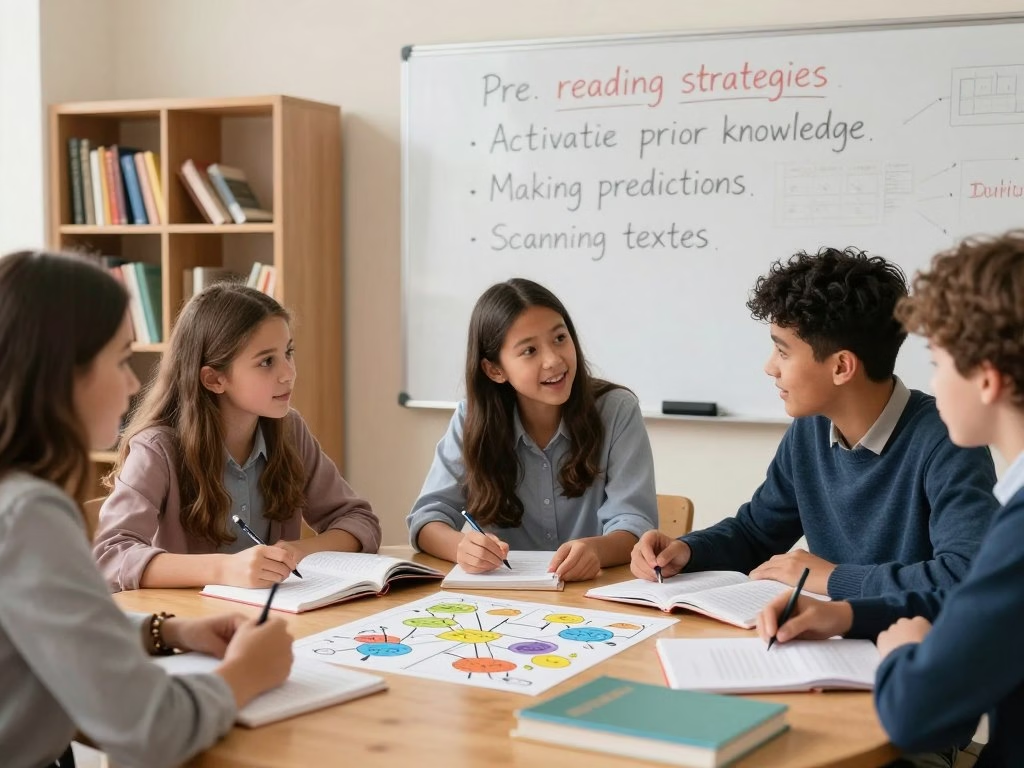
Effective pre-reading strategies are key to better understanding complex texts. By preparing before reading, students can grasp the material more easily. The Learning Center at the University of North Carolina at Chapel Hill says knowing your purpose and using what you already know are vital.
Setting Clear Reading Purposes
Having a clear goal for reading keeps students focused. By knowing what they want to get from their reading, they can plan better. This might mean finding answers to specific questions or looking for certain information.
Previewing Text and Activating Prior Knowledge
Looking at headings, subheadings, and visuals first gives a quick overview. Using what you already know helps link new information to what you already understand. This makes reading easier and more meaningful.
Vocabulary Preparation Techniques
Learning key words before reading helps a lot. You can guess meanings from the context or make lists to review. This way, tackling tough texts becomes less daunting.
| Pre-reading Strategy | Description | Benefits |
|---|---|---|
| Setting Clear Reading Purposes | Defining the goal of the reading task | Improved focus, directed reading |
| Previewing Text | Skimming headings and visual aids | Better understanding of text structure |
| Activating Prior Knowledge | Recalling relevant information or experiences | Enhanced connection to new information |
| Vocabulary Preparation | Pre-learning key terms and using context clues | Increased confidence in tackling challenging texts |
Active Reading Techniques for Better Engagement
Active reading is more than just reading. It’s about really getting into the text to understand and remember it. By using active reading techniques, students can get a lot more out of what they read.
Annotation Methods and Note-taking Systems
Annotation methods and note-taking systems are key for active reading. They let students interact with the text, spot important details, and keep the information in their minds.
Colour-Coding Techniques
Colour-coding is a great way to mark up texts. It lets students sort information, highlight key points, and make a visual guide of the text.
Margin Notes and Symbols
Margin notes and symbols are also effective. Students can use them to mark important bits, ask questions, or show where they’re unsure.
| Technique | Description | Benefit |
|---|---|---|
| Colour-Coding | Using different colours to categorise information | Enhances visual organisation and review |
| Margin Notes | Writing notes in the margins to engage with the text | Improves comprehension and retention |
| Symbols | Using symbols to mark important information or questions | Facilitates quick reference and review |
Questioning Strategies While Reading
Asking questions while reading is a vital technique. It helps students connect with the material, clear up any confusion, and think critically.
Visualisation Techniques
Visualisation means making mental pictures of what you’re reading. It helps students grasp and remember complex stuff by linking it to images.
By using these active reading techniques, students can improve their understanding, interest, and memory of what they read.
How to Improve Reading Comprehension for Students: Evidence-based Approaches
Evidence-based strategies are key to better reading skills for students. They offer a clear way to handle tough texts. Teachers using these methods can really help students grasp and understand written content.
Metacognitive Strategies
Metacognitive strategies teach students to think about their own reading. This makes them more aware of how they read and understand texts. The Institute of Education Sciences says it makes students more engaged with what they read.
Techniques include setting reading goals, checking if they understand, and thinking about their reading process.
Reciprocal Teaching Method
The Reciprocal Teaching Method has students lead discussions on a text. It makes them actively involved and understand better by predicting, questioning, clarifying, and summarizing. It also builds teamwork and deepens text understanding through peer interaction.
Close Reading Practices
Close reading means a detailed look at a text. Students read it several times, focusing on its structure, language, and meaning. It helps them grasp complex texts by noticing the author’s language and literary tools.
| Approach | Description | Benefits |
|---|---|---|
| Metacognitive Strategies | Teaching students to think about their own thinking processes | Enhances self-awareness, improves comprehension |
| Reciprocal Teaching Method | Students take turns leading discussions about a text | Promotes active engagement, collaboration, and deeper understanding |
| Close Reading Practices | Detailed analysis of a text through multiple readings | Develops deeper understanding of complex texts, enhances analytical skills |
Using these evidence-based methods, teachers can greatly improve students’ reading skills. Each method has its own strengths. Together, they form a powerful tool for better reading abilities.
Vocabulary Development Strategies
Good vocabulary skills are key for better reading in students. A wide vocabulary helps them grasp complex texts. It also boosts their school grades.
Contextual Analysis Skills
Contextual analysis is about understanding words in a sentence or passage. It lets students guess the meaning of new words by looking at nearby words. This way, they get better at reading and understanding.
Word Mapping and Semantic Networks
Word mapping and semantic networks show how words are connected. These tools help students link new words to what they already know. This makes learning and remembering easier.
Systematic Vocabulary Building Exercises
Regular practice is important for learning new words. Flashcards, word lists, and quizzes are great for this. Doing these exercises often helps students remember words better.
Using these strategies, students can really improve their reading and school work.
Developing Critical Reading Abilities
It’s key for students to improve their critical reading skills. This means not just getting the text, but also understanding and interpreting it.
Identifying Main Ideas and Supporting Details
Spotting the main ideas and supporting details is a basic skill in critical reading. The Learning Center at the University of North Carolina at Chapel Hill says it’s important to find the key concepts and give examples. Students should know the main points and the evidence that backs them up.
Practising summarising, making concept maps, or outlining main points helps. These activities help students grasp the text’s structure and remember it better.
Analysing Author’s Purpose and Perspective
Understanding the author’s purpose and perspective is also vital. It’s about knowing why the text was written and any biases the author might have. This lets students get a deeper understanding and judge the text’s worth.
Students can ask themselves questions like: What’s the author’s tone? Why did the author choose certain words? How does the author’s goal shape the text?
Evaluating Text Credibility and Relevance
It’s also important to check if a text is credible and relevant. Students should look at the author’s background, the publication’s standing, and how current the text is. This helps them decide if the information is reliable and useful.
By mastering these skills, students become better at reading and understanding complex texts. This boosts their reading skills and academic success.
Technology-Enhanced Reading Comprehension Tools
In today’s digital world, technology is key to better reading skills for students. Many digital tools and platforms help with reading, meeting different learning needs.
Digital Reading Platforms and Applications
Digital reading platforms and apps are getting more popular. They offer personalised learning experiences, letting students read at their own speed. For example, e-book libraries and reading apps have cool features like highlighting and note-taking.
Assistive Technologies for Different Learning Needs
Assistive technologies help students with various learning needs. Tools like text-to-speech software and dyslexia-friendly fonts make reading easier for those with specific challenges.
Interactive Reading Activities Online
Online reading activities, like digital quizzes and forums, make learning fun. They get students involved in reading, helping them understand better.
Creating Supportive Reading Environments
Supportive reading environments can greatly help students love reading. It’s not just about the physical space. It’s also about making a place where learning and fun go hand in hand.
Classroom Strategies for Teachers
Teachers are key in making classrooms supportive for reading. They can do this by setting up reading groups and making sure there are lots of books around.
Organising Effective Reading Groups
Putting students in reading groups helps them learn better together. Teachers can pick books that match each group’s level. This way, every student gets a challenge that’s just right for them.
Creating Reading-Rich Classroom Spaces
A good classroom for reading has lots of books and materials. This includes stories, facts, magazines, and digital stuff. It lets students try out different types of reading.
Home Reading Practices for Parents
Parents play a big part in keeping reading fun at home. Setting up a cozy reading spot and making reading a regular part of life can make it enjoyable for kids.
Collaborative Reading Communities
Reading communities outside of school and home are also important. They can be in schools, libraries, or online. These groups bring together students, teachers, and parents to share their love of reading.
By working together, teachers and parents can make reading environments that help students understand and enjoy books. This way, they can keep loving to read for their whole lives.
Measuring and Tracking Reading Comprehension Progress
It’s important for teachers and parents to know how to check if students are getting better at reading. This helps find out where they might need extra help. It’s a big part of helping students improve their reading skills.
Formal and Informal Assessment Methods
There are many ways to check if students are understanding what they read. Formal tests give a clear picture of their reading skills. On the other hand, watching students read and talking to them about it can give more detailed insights.
The Read Naturally says, “checking how well students are doing and keeping track of their progress is very important for teaching reading well.”
| Assessment Type | Description | Benefits |
|---|---|---|
| Formal Assessments | Standardised tests and evaluations | Provides a structured evaluation of reading abilities |
| Informal Assessments | Observations and reading conferences | Offers insights into reading behaviours and comprehension |
Setting Achievable Reading Goals
Setting goals that students can reach is key to keeping them motivated. Clear goals help students stay focused on improving their reading. Goals that are specific, measurable, achievable, relevant, and time-bound (SMART) work best.
Celebrating Reading Milestones
It’s great to celebrate when students reach reading goals. Recognising their achievements, big or small, boosts their confidence. It encourages them to keep working on their reading skills.
Using these methods, teachers and parents can really help students get better at reading. It’s all about making progress and celebrating every step along the way.
Conclusion: Fostering Lifelong Reading Skills
It’s vital for students to develop lifelong reading skills. This helps them succeed in the long run. By using good reading techniques, they can understand and enjoy reading more.
Many strategies can help students get better at reading. These include active reading, learning new words, and critical thinking. The Learning Center at the University of North Carolina at Chapel Hill says it’s key to use these strategies well. This helps students remember what they read for a long time.
By using these strategies, students can really get into what they’re reading. This not only improves their grades but also opens up more chances for them in the future. Good reading skills are key to enjoying reading for life.