
 Paul Scott
Learning well isn’t just about how long you study. It’s about making information easy for your brain to use. A good study guide can really help students get ready for exams and keep information in their minds.
With a study guide template, students can make their exam prep easier. They can focus on the most important stuff. This way, they can check and strengthen their understanding, which helps them do better in school.
Key Takeaways
- Organising information is key to effective learning.
- A study guide template can enhance exam prep.
- Streamlining study materials improves retention.
- Focused revision leads to better academic outcomes.
- Using a study guide can reduce study time.
Why Personalised Study Guides Transform Your Learning

The power of study aids comes from being made just for you. Customised learning materials help students do better in school.
Personalised study guides make studying easier and less stressful. They break down hard topics into simple bits. This helps students focus better and feel more confident.
These guides work for everyone, no matter how you learn best. Visual learners get diagrams, while those who hear better get audio. It’s all about what works for you.
Academic support is a big plus of these guides. They help where you need it most. This way, you can fill in knowledge gaps and really get what you’re learning.
In short, personalised study guides change the game. They offer academic support and fit your learning style. This makes learning easier and more effective.
Understanding the Core Elements of Effective Study Guides

A well-made study guide can change how you study. It helps you understand, remember, and get ready for exams. It does this by having a few key parts.
Key Components Every Study Guide Should Include
Good study guides have basic parts that help you learn. These essential components make it easier to get and keep information.
- Clear Topic Organisation: Organising topics in a logical way makes studying easier.
- Key Terms and Definitions: Important words and clear definitions help you understand complex ideas.
- Concise Explanations: Breaking down hard information into simple bits helps you get it.
- Visual Aids: Using diagrams and charts helps you remember and understand better.
Choosing the Right Format for Your Learning Style
Everyone learns differently, and the study guide’s format matters. There are a few main types:
- Outline-Based Study Guides: Great for those who like a structured way of learning.
- Question-and-Answer Formats: Good for checking your knowledge and making it stick.
- Visual Study Guides: Mind maps and diagrams are best for those who learn visually.
Knowing the key parts and picking the right style helps you make personalised study resources. This makes learning better for you.
How to Create Study Guides: A Step-by-Step Framework

Making a good study guide needs a clear plan. This helps you sort out your study stuff well. You’ll make sure your guide covers everything you need to know.
Gather and Organise Your Course Materials
Start by collecting all your course stuff. This includes notes, slides, books, assignments, and review sheets. Make sure you have everything so you don’t miss out on key points.
- Lecture notes and slides
- Readings or textbooks
- Assignments and review sheets
Identify Key Concepts and Prioritise Information
After you’ve got all your materials, find the most important ideas. Pick out the most critical info for your studies.
| Key Concept | Importance Level | Relevance |
|---|---|---|
| Understanding study guides | High | Very Relevant |
| Organising materials | Medium | Relevant |
| Prioritising information | High | Very Relevant |
Structure Your Content Logically
Arrange your study guide in a way that makes sense. You might use an outline or headings. A clear layout helps you understand and remember better.
Add Visual Elements and Memory Aids
Adding pictures, charts, and diagrams can make your guide better. Mnemonics also help remember tricky stuff.
- Diagrams and flowcharts
- Charts and graphs
- Mnemonics and acronyms
Creating Study Guides for Mathematics and Quantitative Subjects

Making study guides for maths and quantitative subjects is more than just copying notes. It needs a smart plan. Good study guides help students grasp and use maths concepts and formulas to solve problems.
Formula Sheets and Problem-Solving Frameworks
A key part of maths study guides is a detailed formula sheet. It should list important formulas and show when and how to use them. Also, a problem-solving framework helps students tackle complex problems step by step. This includes understanding the problem, finding the right formulas or concepts, and verifying the solution.
- List key formulas and their applications
- Provide examples for each formula
- Outline a step-by-step problem-solving process
Worked Example Template for Algebra
For algebra and other maths areas that deal with solving equations, a worked example template is very helpful. It shows students how to solve a problem step by step, explaining each step.
- State the problem
- Outline the steps to solve it
- Explain the reasoning behind each step
- Provide the solution and check it
Practice Problem Sets with Solution Guides
Practising is key to getting better at maths. A good study guide should have practice problem sets of different levels. It should also offer solution guides that explain how to solve problems, not just the answers.
- Include a variety of problem types and difficulties
- Provide detailed solutions to practice problems
- Encourage students to check their work and understand mistakes
By adding these features, study guides for maths and quantitative subjects can really help students improve their understanding and results.
Building Study Guides for Science Subjects
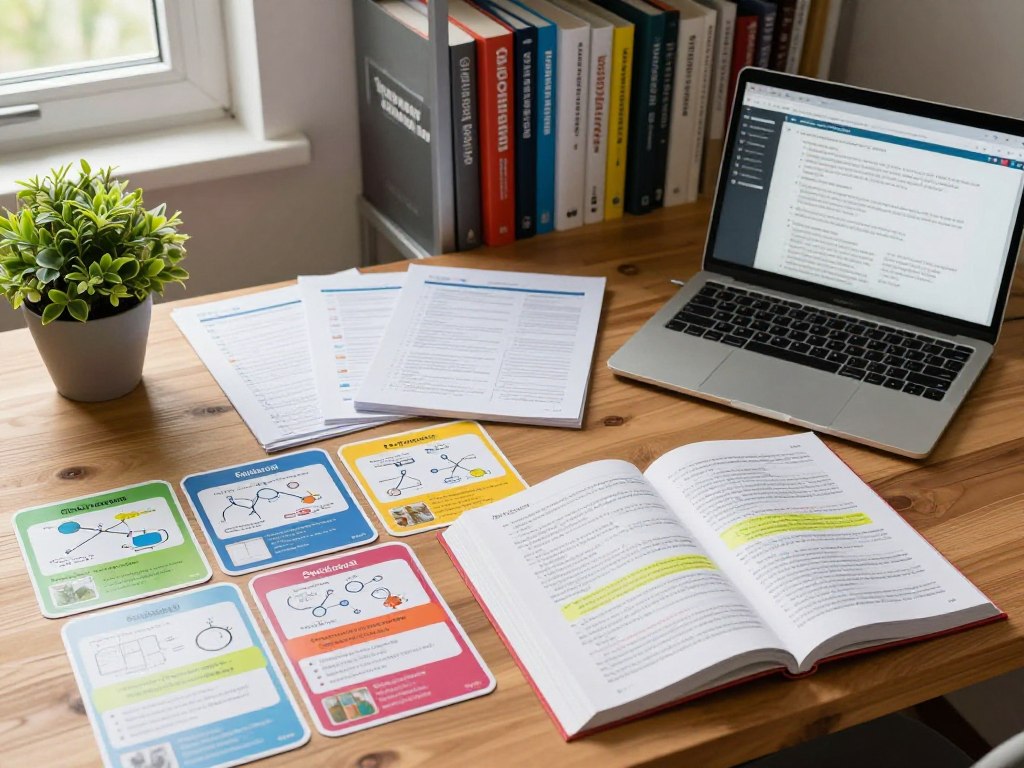
To do well in science, students need study guides full of pictures and easy to follow. Science, like biology, chemistry, and physics, has complex ideas. These can be hard to get without the right tools.
Effective study guides for these subjects should have lots of pictures. Diagrams, charts, and maps help students see how things connect. This makes learning easier and more fun.
Biology: Process Diagrams and Classification Charts
In biology, process diagrams are key for showing how things work, like how cells make energy. They break down complex steps into simple ones. Classification charts help sort out different living things. This makes studying and remembering easier.
Chemistry: Reaction Maps and Periodic Table Annotations
In chemistry, reaction maps show how chemicals react with each other. They help students see how reactions link together. Notes on the periodic table highlight important elements and their roles in reactions.
Physics: Concept Maps with Real-World Applications
In physics, concept maps show how different ideas, like force and energy, are connected. Adding real-world applications makes these ideas more interesting and useful.
Using these visual tools in study guides makes learning science fun and effective. It helps students understand and remember science better.
Developing Study Guides for History and Social Studies
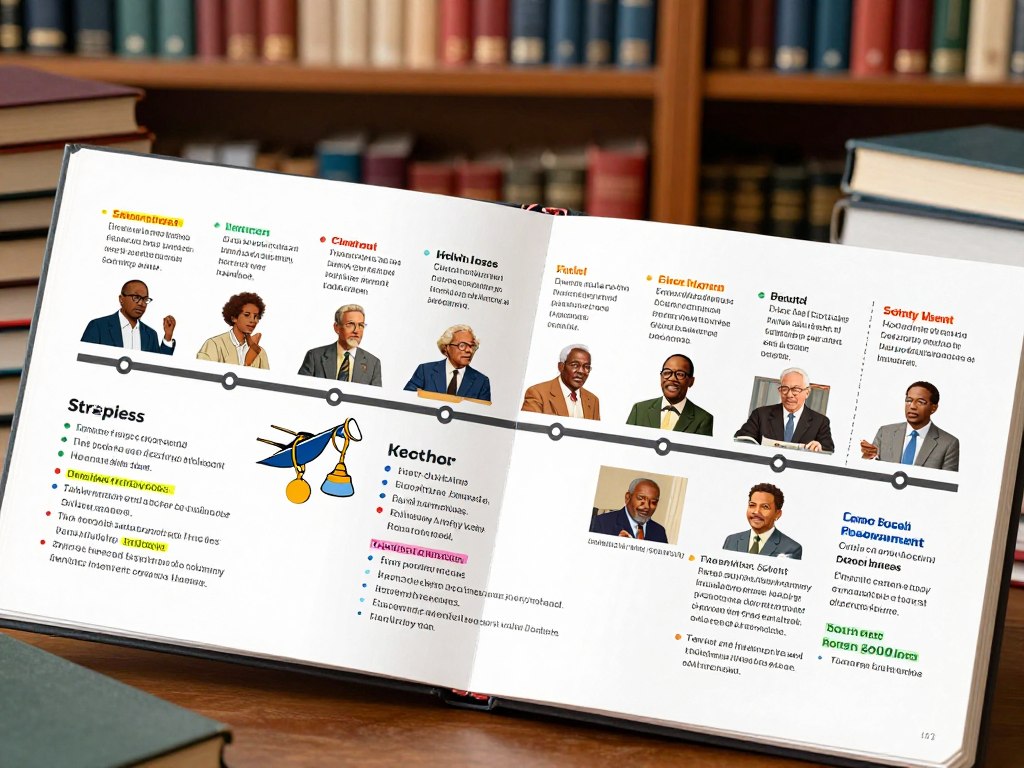
Creating study guides for history and social studies is more than just memorising dates. It’s about understanding the context and connections between events. Students need to organise historical information in a way that’s easy to review and recall.
Timeline-Based Revision Notes
Studying history can be made easier by using timeline-based revision notes. Plotting key events on a timeline helps visualise historical periods. This way, students can see the sequence of events and their connections.
To make a timeline, first identify the key events or periods you need to study. Then, use a large piece of paper or a digital tool to create a timeline. Mark important dates and events, and include brief notes or images to help remember.
Cause-and-Effect Analysis Templates
Another useful tool is the cause-and-effect analysis template. It helps understand the significance of historical events by identifying causes and consequences.
To create one, start by picking a historical event or period to study. Use a template to analyse the causes and effects of the event.
| Event | Causes | Effects |
|---|---|---|
| American Revolution | Taxation without representation, Enlightenment ideas | Independence from Britain, establishment of a new government |
| French Revolution | Financial crisis, social inequality, Enlightenment ideas | Overthrow of the monarchy, Reign of Terror, rise of Napoleon |
Comparative Study Guide Example for Historical Events
Comparative study guides are also helpful. They allow students to understand historical events by comparing and contrasting them. This helps see similarities and differences.
To create a comparative study guide, pick two or more historical events or periods to compare. Use a template to organise your notes.
- Event 1: American Revolution
- Event 2: French Revolution
- Similarities: Both were influenced by Enlightenment ideas, both involved a revolution against a monarch or government
- Differences: The American Revolution focused on independence, while the French Revolution focused on social change
By using these study guide techniques, students can gain a deeper understanding of historical events. This makes it easier to review and recall information for exams.
Crafting Study Guides for Literature and English
Study guides for Literature and English can really help students understand complex texts better. These guides are educational aids that open up the world of literature. They make learning more enjoyable and effective.
When making study guides, it’s key to include tools that help students grasp texts better. This means using character analysis charts, theme trackers, and guides on literary devices. These tools are essential learning tools for students.
Character Analysis Charts and Theme Trackers
Character analysis charts are great for tracking how characters change in a story. They help students compare and contrast characters, noting their traits and actions. Theme trackers do the same for themes in a text.
For instance, a character analysis chart might have columns for name, traits, actions, and relationships. This makes it easy for students to see how characters affect the story.
Literary Device Reference Guides
Literary devices are what writers use to add meaning and effect to their work. A guide on these devices helps students understand them, from metaphors to symbolism.
With a detailed guide, students can quickly look up devices as they read. This improves their understanding and appreciation of literature.
Essay Structure Templates with Examples
Essay writing is a key skill for Literature and English students. Giving them essay templates helps them write better essays. These templates ensure essays are well-organized and clear.
Templates include sections for introduction, thesis, body paragraphs, and conclusion. By using these, students can craft strong arguments backed by text evidence.
In summary, making study guides for Literature and English involves creating various study tips and tools. By using character charts, theme trackers, literary device guides, and essay templates, students can better understand literature. This improves their academic performance.
Designing Study Guides for Foreign Languages
Creating study guides for foreign languages is more than just gathering info. It’s about making a system that helps you learn the language. Good study guides cover vocabulary, grammar, and how to have conversations.
Vocabulary Organisation Systems
Organising vocabulary is key for language learners. You can do this by:
- Grouping words by theme (like food, travel, family)
- Using flashcards with new words and their meanings
- Learning mnemonics to remember words better
Grammar Rule Quick-Reference Cards
Grammar rules can be tough and confusing. Quick-reference cards help by:
- Putting key grammar rules on index cards
- Creating a booklet for easy access to grammar rules
- Using colours to show different grammar ideas
These cards are a great tool for learning and checking grammar rules.
Conversation Practice Scenarios
Practising conversations is essential for using your language skills in real life. Study guides can include:
- Role-play scenarios for different situations (like ordering food or making reservations)
- Common phrases and expressions for everyday talks
- Audio recordings or online tools for listening practice
By adding these elements, learners can get better at speaking and listening.
In summary, making study guides for foreign languages needs a mix of approaches. It should cover vocabulary, grammar, and conversation skills. By using the strategies mentioned, learners can make effective study resources that help them improve their language skills.
Study Guide Techniques for Business and Economics
Creating study guides for business and economics needs a deep grasp of theory and its use in real life. Students must move past just memorising and apply what they learn to real situations.
Good study guides for these subjects use a few key methods. Two top methods are making Theory Application Matrices and Case Study Analysis Frameworks. These tools help students organise their knowledge and think critically.
Theory Application Matrices
A Theory Application Matrix links theoretical ideas to real-world business or economic scenarios. It lets students see how theories solve problems or explain complex issues.
- Identify key theories and concepts relevant to the subject matter.
- Create a grid with theories on one axis and possible application areas on the other.
- Fill in the matrix with examples or case studies that show how each theory is applied.
In economics, for example, a Theory Application Matrix can show how economic theories (like supply and demand, opportunity cost, or comparative advantage) apply to real economic issues or business decisions.
Case Study Analysis Frameworks
Case studies are key in business and economics education. A Case Study Analysis Framework offers a structured way to study these cases, ensuring students cover all important points.
- Background: Give context for the case study.
- Problem Identification: Clearly state the main issues or problems in the case.
- Analysis: Use relevant theories or frameworks to analyse the case.
- Recommendations: Offer possible solutions or actions based on the analysis.
- Conclusion: Sum up the main findings and their implications.
By using these frameworks, students can think more critically about complex business or economic scenarios. This makes them better ready for exams and real-world challenges.
In conclusion, by adding Theory Application Matrices and Case Study Analysis Frameworks to their study guides, business and economics students can greatly improve their exam prep. They will also gain a deeper understanding of their subjects.
Digital vs Handwritten Study Guides: Finding Your Method
Digital tools have changed how we make study guides. Yet, handwritten notes are also valuable. This section looks at the good and bad of both to help you choose what suits you best.
Digital study guides have many benefits. They are easy to access, organise, and share. You can quickly find what you need, mark important bits, and update them easily. This makes sure you always have the latest info.
Best Tools and Apps for Digital Study Guides
There are many digital tools and apps to help with study guides. Here are some popular ones:
- Evernote: A versatile app for organising notes with tags and search.
- Notion: A workspace that combines notes, databases, and project tools.
- OneNote: A digital app that works well with Microsoft Office.
- Quizlet: A study app with flashcards, tests, and games for many subjects.
These tools can make creating, organising, and reviewing digital study guides easier. This makes studying more efficient and effective.
When Handwritten Notes Work Better
Handwritten notes also have their benefits. They help you remember things better because they engage your brain more. They are also more personal and less distracting, helping you connect with the material deeper.
Benefits of Handwritten Notes:
- Improved retention through kinesthetic learning.
- Enhanced creativity and personalisation.
- Reduced distractions compared to digital devices.
Choosing between digital and handwritten study guides depends on what works best for you. Knowing the strengths of each can help you create a study system that boosts your learning.
Optimising Your Study Guides for Active Recall and Retention
To keep information in your mind, make your study guides for active recall. Active recall means you actively try to remember things. This makes you better at remembering them. By using certain methods in your study guides, you can learn more effectively.
Incorporating Self-Testing Elements
Adding self-testing parts to your study guides is a smart move. You can make flashcards, quizzes, or summary sheets to check your knowledge. Self-testing boosts your ability to recall information later. For example, you can make flashcards with questions on one side and answers on the other. Or, you can create quizzes with key terms and concepts.
Spacing Out Revision with Your Study Materials
Spacing out your study sessions is also key. This means reviewing material at longer intervals to keep it in your memory. It helps avoid forgetting important information. A good way to do this is by making a schedule for when to review each topic.
| Revision Session | Topic | Revision Technique |
|---|---|---|
| 1 | Introduction to Psychology | Summary Notes |
| 2 | Biological Psychology | Flashcards |
| 3 | Cognitive Psychology | Practice Quiz |
Using these methods in your study guides can make them very effective. Active recall and spaced revision are backed by science and can really help you do well in school. The best study guides don’t just repeat information. They make you actively engage with it through testing and spaced review.
Common Mistakes When Creating Study Guides and How to Avoid Them
Making a study guide can be tricky. Students put a lot of effort into making study resources to improve their grades. But, without the right tips, they might make mistakes that lessen the guide’s value.
Students often face the challenge of avoiding common mistakes in their study guides. Knowing these pitfalls and how to dodge them helps learners make better study materials.
Information Overload vs Strategic Summarising
One big mistake is information overload. Students try to include everything from their notes, making the guide too full. Instead, strategic summarising helps focus on the most important bits.
To steer clear of too much info, it’s key to pick out the most vital points and summarise them well. This can be done by:
- Breaking down big topics into smaller, easier parts
- Using headings and subheadings to keep things in order
- Marking down key terms and ideas
Passive Copying vs Active Processing
Another mistake is passive copying from textbooks or notes into the guide. This doesn’t really help in understanding or remembering. On the other hand, active processing means really engaging with the material, rewriting it in your own words, and linking different bits of info together.
To encourage active processing, students can:
- Make concept maps or diagrams to show how ideas are connected
- Write out notes in their own words, not just copying
- Make self-test materials to help solidify learning
By knowing these common errors and how to sidestep them, students can make study guides that really help. This can make learning better and improve their grades.
Conclusion
Making a study guide is not just a task. It’s a way to learn that changes how you study for exams. It helps you understand and remember important information better.
In this article, we’ve looked at what makes a good study guide. We’ve talked about how to gather and sort out your study materials. We’ve also discussed adding pictures and memory tricks to help you learn.
Whether you’re studying maths, science, literature, or a foreign language, a good study guide is key. It’s made just for you, based on how you learn best.
Using the tips from this article, you can make study guides that help you get ready for exams. They also help you understand your subject better. As you get better at making study guides, studying for exams will feel easier and less scary.
FAQ
What is the best way to create a study guide?
Start by gathering and organising your course materials. Identify key concepts and structure your content logically. Tailor your study guide to fit your learning style.
How do I make my study guides more effective for exam preparation?
Make your study guides effective by adding self-testing elements. Space out your revision and use active recall techniques. Visual aids like diagrams can also help reinforce your learning.
What are the benefits of using digital study guides?
Digital study guides are accessible and flexible. They’re easy to update and organise. You can use digital tools and apps to create interactive guides and access them anywhere.
Can I use handwritten notes as a study guide?
Yes, handwritten notes are effective, even for subjects like problem-solving or essay writing. They help you retain information better and offer a personal touch to your learning.
How do I create a study guide for a specific subject, such as mathematics or literature?
For specific subjects, identify key concepts and topics. For mathematics, create formula sheets and problem-solving frameworks. For literature, make character analysis charts and theme trackers.
What are some common mistakes to avoid when creating study guides?
Avoid information overload and passive copying. Don’t forget to review and update your materials regularly. Keep your study guides concise and easy to follow.
How can I use study guides to improve my retention and recall?
Use your study guides to actively recall information. Techniques like self-testing, summarising, and spaced repetition can help reinforce your learning.
Can I use study guides for group study sessions?
Yes, study guides are great for group study sessions. They help structure discussions, identify key concepts, and provide a shared learning framework.
How often should I review and update my study guides?
Review and update your study guides regularly, as you progress through your course. This keeps your guides relevant and effective for your learning.