
 Paul Scott

For dissertation research, choose your sampling method by matching who you need to study with the conclusions your research question requires. Amongst dissertation sampling methods, probability approaches support population estimates, whilst non-probability approaches suit targeted exploration or restricted access.
Your choice must also work within your timetable, recruitment permissions and analytical skills. Start with the claims you need to support, then decide whose evidence can support them.
Key Takeaways
- Define your population, sampling frame and sample separately.
- Use probability sampling for statistical generalisation, provided coverage and response support it.
- Choose non-probability sampling when access or relevant experience guides selection, and acknowledge its limits.
- Justify sample size through analytical requirements or qualitative depth, rather than copying another dissertation’s participant count.
Define Your Population, Sampling Frame and Sample
Your population is the full set of people, organisations, documents or other units your intended conclusions concern.
The sampling frame is the practical list from which you select units. A university enrolment register could provide a frame for sampling students. However, an outdated register might omit recent entrants or include students who have left.
Your sample is the subset actually studied. Distinguish those selected or invited from those who eventually participate.
When no complete list exists, say so. Describe the recruitment channels, eligibility criteria and accessible groups instead. An open social-media invitation doesn’t provide a complete frame of everyone eligible.
This distinction determines what your findings can cover. A sample recruited through one university isn’t automatically a representative sample of UK higher education and can’t establish sector-wide patterns.
Match Dissertation Sampling Methods to Your Question
First, identify whether you need measured distributions, relationships or detailed accounts of experience. Our guide to developing a focused research question helps establish those boundaries.
Probability sampling gives every population unit a known, non-zero selection chance. With appropriate analysis, sampling error can be estimated and cautious claims of generalisability are possible, though incomplete coverage and non-response can weaken them.
Non-probability sampling uses convenience, judgement, quotas or referrals. Selection probabilities are unknown, so it doesn’t justify design-based statistical generalisation.
National University’s guide to sampling methods{target=”_blank” rel=”nofollow”} provides a useful reference for these distinctions.
Next, assess access. Population estimates usually require a suitable frame and probability selection. Interviews about professional decision-making may instead require participants with relevant experience.
Finally, align selection with analysis. Quantitative research can use non-probability samples, but numerical analysis doesn’t remove selection bias. Mixed-methods studies may need different sampling strategies for their survey and interview components.
Probability Sampling Methods
Simple Random and Systematic Sampling
Simple random sampling gives every unit an equal selection chance. For 1,000 individuals, label records 000 to 999. Read a random number table in three-digit groups, skipping duplicates when sampling without replacement.
Systematic sampling selects every N/n-th unit after a random starting point. To select 100 from 1,000, choose a start amongst the first ten entries, then take every tenth member.
However, periodic ordering can distort selection. If recurring list positions correspond to particular shifts or roles, the interval may repeatedly capture the same type of person.
Stratified Sampling
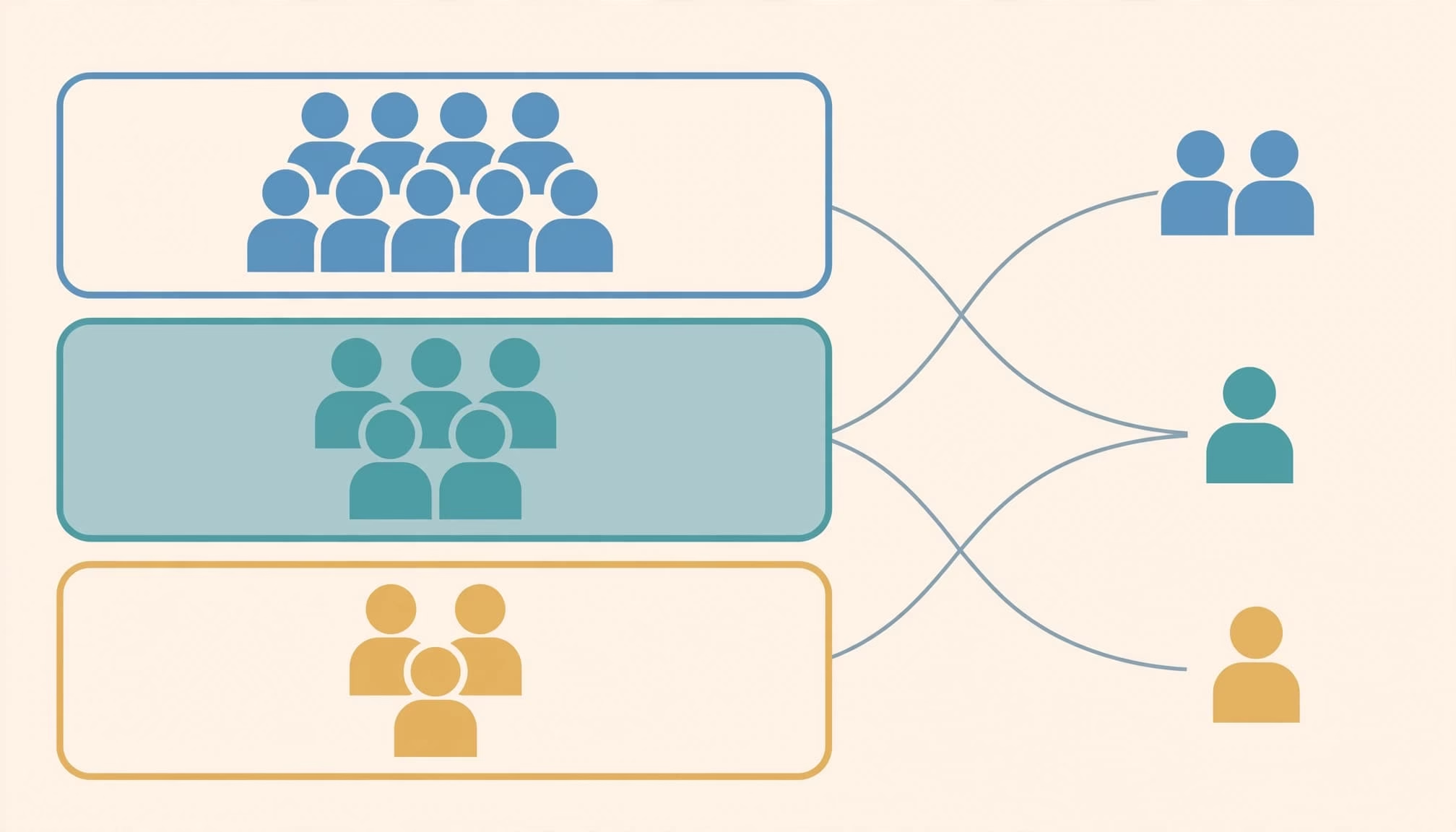
Stratified sampling divides the population into relevant subgroups, then randomly samples within each.
For hospitals employing 500, 1,000 and 2,000 nurses, proportional samples of 10, 20 and 40 produce 70 participants. Each hospital contributes the same sampling fraction.
Choose stratification when subgroup coverage matters. Unlike simple random sampling, it deliberately includes each defined stratum. Disproportionate allocation can support subgroup comparisons, but population estimates may require weighting.
Cluster and Multistage Sampling
Cluster sampling randomly selects whole groups, such as GP practices or towns. Concentrating fieldwork reduces travel costs across dispersed populations.
However, people within clusters often resemble one another. This similarity can increase sampling error compared with simple random sampling.
Multistage sampling selects units in successive stages. A crop survey might select villages as primary units, fields as secondary units, then plots within fields. Record the selection procedure at every stage.
Non-Probability Sampling Methods

Convenience and Quota Sampling
Convenience sampling recruits people who are easiest to reach. It’s straightforward, but accessible participants may differ from everyone else. Open invitations also create volunteer bias because volunteers may have stronger interests or different experiences.
Quota sampling sets subgroup targets without requiring random selection within them. A traditional radio-survey example allocates every 100 interviews to 60 “housewives”, 25 farmers and 15 children.
That dated example illustrates allocation, not suitable modern categories. Your quotas should use relevant, clearly defined groups and avoid ambiguous overlaps.
Meeting quotas doesn’t make recruitment random. Interviewers may still select the most accessible people within each group.
Purposive and Snowball Sampling
Purposive sampling, also called “judgment sampling” in some research texts, selects participants because their characteristics suit the question. For example, research on experienced IT management could recruit IT managers with at least five years’ experience.
It’s common in qualitative research because eligibility depends on relevant knowledge. Explain why those characteristics matter and whether you need contrasting perspectives.
Snowball sampling asks participants to nominate others. It can help reach hidden or difficult-to-access populations, but referrals often follow socially similar networks.
Therefore, record referral routes and consider separate recruitment starting points. Protect confidentiality by allowing potential participants to contact you themselves rather than collecting their details without permission.
Set a Sample Size Your Analysis Can Support
Quantitative Studies: Power and Precision
For hypothesis-testing research, justify sample size through an appropriate power analysis. The G*Power sample-size tutorial{target=”_blank” rel=”nofollow”} explains how calculations relate to statistical tests.
A target of 150 participants for a medium effect at 80% power is defensible only when the calculation matches the planned analysis. It isn’t a universal dissertation requirement.
For descriptive estimates, precision may be the main consideration. Also account for non-response and the sampling design.
If access falls below your justified requirement, narrow the question or acknowledge reduced sensitivity. Don’t interpret a non-significant result as proof that no relationship exists.
Qualitative Studies: Depth and Saturation
Qualitative sample size depends on the question, participant diversity, interview depth and analytical approach.
For designs using data saturation, analyse during recruitment and document when further interviews stop adding relevant information. Explain what saturation meant and how you assessed it.
A stopping decision requires evidence, rather than a sentence claiming that saturation occurred.
Also match your adequacy argument to your analysis. Our guide to thematic analysis for dissertation interviews explains how interpretation develops across the dataset. A narrowly defined group may require different coverage from a study comparing several settings.
Address Five Common Sources of Sampling Bias
Five recurring problems deserve explicit attention: departures from agreed selection rules, omission of hard-to-reach groups, replacement of selected individuals, low response rates and outdated sampling frames.
Prevent rule changes by recording your procedure before recruitment. Offer appropriate recruitment routes for groups your main channel might miss. Also establish how you’ll handle refusals, rather than substituting whoever is nearby.
For non-response, report the number approached where known. Compare respondent characteristics with available population information when possible.
A larger sample can improve precision without correcting selection bias.
Explain constraints beside the decisions that create them. Then discuss their effects on interpretation later. Our guidance on explaining dissertation limitations shows how to connect restrictions with particular claims.
Write a Sampling Section an Examiner Can Assess
Your research methods section needs both procedural detail and reasons for each sampling choice. Naming “purposive sampling” or “random sampling” leaves essential decisions unexplained.
Use this sequence:
- Define the population, setting, eligibility criteria and sampling frame, including missing coverage.
- Describe the selection method and recruitment process, identifying who approached participants and how.
- Justify the intended sample size, then report invitations, responses, exclusions and the final sample where applicable.
- Explain departures from the plan, ethical safeguards and consequences for your conclusions.
Separate selection from recruitment. Randomly selecting names doesn’t guarantee participation, whilst voluntary consent doesn’t make a study convenience sampling.
For completed research, describe what happened in the past tense. A proposal should describe planned procedures in the future tense.
Our dissertation methodology examples show how sampling fits the wider design. Adapt the reasoning and structure, but never borrow another study’s recruitment claims or ethical approvals.
Also calculate response rates using an appropriate invitation denominator, not your recruitment target. If you don’t know how many eligible people received an open invitation, state that limitation.
Frequently Asked Questions About Dissertation Sampling Methods
Can I Use Convenience Sampling for Quantitative Research?
Yes. You can measure variables and analyse relationships within a convenience sample. However, you must explain recruitment bias and limit population-level claims. Sample size and selection quality are separate issues.
Is Random Sampling the Same as Random Assignment?
No. Random sampling determines who enters the study. Random assignment allocates participants to study conditions. An experiment can randomly assign a convenience sample without obtaining a representative population sample.
Where Can I Document a Power Calculation?
Report the software, intended analysis and calculation assumptions in your methodology. The official G*Power 3.1 manual{target=”_blank” rel=”nofollow”} explains the available analysis procedures.
What Changes for a Systematic Review?
You select studies through a documented search and eligibility process rather than recruiting participants. A PRISMA 2020 flow diagram{target=”_blank” rel=”nofollow”} records identification, screening, exclusions and inclusion, with reasons for full-text exclusions.
Choose a Method You Can Justify
A defensible sampling strategy connects your question, accessible population and intended conclusions. Its justification matters more than how sophisticated the method sounds.
Define who could enter your study, explain how selection occurred and support your sample-size decision. Then keep your conclusions within those boundaries.
Before recruitment begins, write that account in plain language. Gaps in the explanation often reveal practical problems while there’s still time to address them.