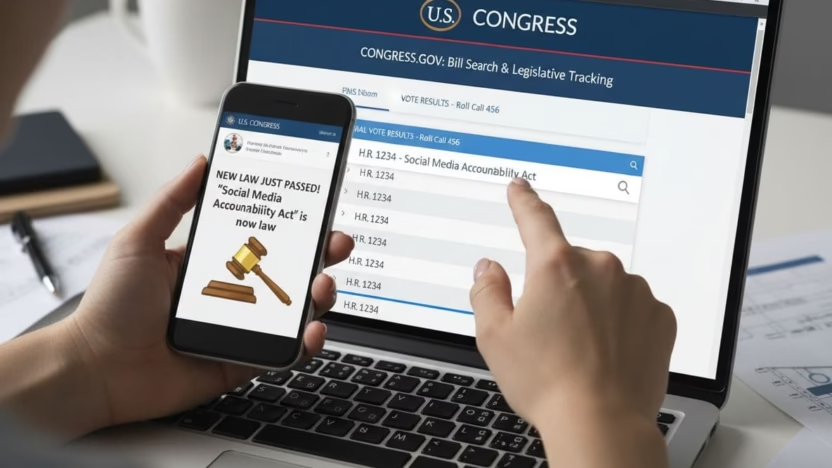
You’re scrolling between lectures, group chats, and revision breaks, and someone posts: “New law just passed. Share before they delete this.” It feels urgent, like a fire alarm in text form.
Most of the time, it’s missing context, mixing up countries, or confusing a bill with a law. The good news is you can verify new law claims in minutes, using the same official pages journalists and researchers rely on.
Key Takeaways
- “Passed” can mean many things, from “introduced” to “signed into law”.
- Start by pinning down the country and level (national, state, local).
- Use an official bill tracker to check the bill’s latest action and full text.
- Use official vote pages to confirm what actually happened on the floor.
- Look for the final step, such as a public law number or signature, not just headlines.
Table of Contents
- Key Takeaways
- First, translate the post: what does “passed” even mean?
- Step 1: Capture the claim and lock down the basics
- Step 2: Check the official bill tracker for real status (not vibes)
- Step 3: Verify the votes on official vote pages (and learn what’s missing)
- Step 4: Confirm it became law, not just “passed somewhere”
- Quick red flags that usually mean “this post isn’t reliable”
- A fast example walkthrough (what you’d do in 3 minutes)
- Conclusion
- Frequently Asked Questions About checking if a “new law just passed” post is real
First, translate the post: what does “passed” even mean?
A lot of misinformation works like a dodgy magic trick: it changes the meaning of one word while you’re looking elsewhere. In law-making, “passed” is one of the slipperiest words.
| What a post says | What it might mean in real life | Why it matters |
|---|---|---|
| “A new law passed” | A bill was introduced, debated, or amended | Nothing is binding yet |
| “It passed” | It passed one chamber only | It can still fail later |
| “It’s now law” | It may still need a signature or final approval | The key step might not have happened |
If you remember just one thing: a bill is not automatically a law.
Step 1: Capture the claim and lock down the basics
Before you click anything, copy the key details from the post (or screenshot it). You’re looking for:
1) Jurisdiction: Is this about the UK, the US, Canada, or somewhere else?
2) Level: National law, devolved government, state, or local council?
3) Name/number: Any bill number like “H.R. 1234”, “S. 50”, or a named act?
4) Date: “Passed last night” is a clue you can test against official timelines.
5) The actual change: What does it claim will happen, to whom, and when?
If a post has none of these, treat it like a half-written citation in an essay. It’s not proof, it’s a prompt to check.
Step 2: Check the official bill tracker for real status (not vibes)
For US federal claims, the cleanest starting point is the official tracker: Congress.gov. Search the bill number if you have it, or use a few specific keywords from the claim.
When you open a bill page, focus on three sections:
The “Latest Action” line (your fastest truth test)
This shows the most recent official step. If the post claims “it passed”, but the latest action says “introduced” or “referred to committee”, the post is wrong or premature.
The actions timeline (a receipt trail)
Official timelines are boring on purpose. That’s what makes them useful. A viral post is a highlight reel, the actions list is the full match recording.
For example, an “All Actions” page looks like this: Actions for H.R.1 in the 119th Congress. You don’t need to read every line, just scan for major milestones (passage, conference, presented to the President, signed).
The bill text (because summaries get twisted)
If the post claims a ban, a fine, or a new requirement, open the text version and search within it for the key term (Ctrl+F). People often share a screenshot of someone’s summary of someone else’s summary, and small wording changes can flip the meaning.
If you want an extra cross-check that’s easier to browse (but not official), GovTrack’s bill search can help you spot whether you’re looking at the right bill and whether it’s moving.
Step 3: Verify the votes on official vote pages (and learn what’s missing)
A post might say “they voted it through”, but you should still verify:
- Was there a recorded vote (roll call)?
- Which chamber voted?
- What was the result and date?
For US Senate vote records, use the official guidance on how to find congressional votes. It also explains a key point that social posts love to ignore: not every vote is a named roll call vote. Some are voice votes, which won’t show you how each member voted.
So if a post claims “your senator voted yes”, and there was no roll call, it may be guessing.
Step 4: Confirm it became law, not just “passed somewhere”
To verify new law claims properly, you need the “end of the conveyor belt” proof.
For US federal law, reliable confirmation includes:
A signature or “signed into law” notice
White House briefings can confirm when a bill is signed, for example: CONGRESSIONAL BILL S. 1071 SIGNED INTO LAW. Use these as confirmation of the final step, then still trace back to the bill page for details.
A public law number
The National Archives maintains current public law numbers here: Public Laws: Numbers for the Current Session of Congress. If the post claims “this is now federal law”, but you can’t find the law number for that bill, it’s likely not enacted.
For Canada, look for Royal Assent on the official parliamentary pages, for example: Bill C-3 Royal Assent (Parliament of Canada).
For the UK, the equivalent “final step” is Royal Assent, but viral posts often confuse this with announcements, consultations, or proposed bills. Some posts in 2025 also twisted real changes (such as the ban on fake reviews starting April 2025) into bigger claims than the law actually says, so always check the official wording.
Quick red flags that usually mean “this post isn’t reliable”
- It says “new law” but gives no bill name, number, or link.
- It uses “passed” but never says where (which chamber, which country).
- It claims it “starts tomorrow”, but real laws often have start dates written into the text.
- It relies on a cropped screenshot rather than a source you can open.
- It frames it as “they don’t want you to know”, while the votes and actions are public record.
If you want a wider view of how misinformation spreads and why platforms reward it, this discussion is a useful backdrop: https://thestudyjournal.com/should-social-media-platforms-be-held-liable-for-the-spread-of-misinformation/
A fast example walkthrough (what you’d do in 3 minutes)
Let’s say a post claims: “Congress passed a bill to ban X last night.”
- You search the key phrase on Congress.gov.
- You open the most relevant bill and read “Latest Action”. If it says “Referred to the House Committee…”, it didn’t pass last night.
- You open the actions list and check dates. If there’s no “Passed House” or “Passed Senate”, the post is overstating.
- You check vote records using the Senate vote guidance if the claim involves the Senate.
- If it claims “it’s law now”, you look for a signature notice or a public law number on the National Archives page.
That’s it. No guesswork, no arguing in comments.
Conclusion
The internet is full of posts that sound like law, but aren’t law. Once you learn to use official trackers and vote pages, you can verify new law claims with calm, checkable evidence. Save the links, practice on one viral post, and you’ll get quicker every time. The next time someone says “this just passed”, you’ll know exactly what to look for.
Frequently Asked Questions About checking if a “new law just passed” post is real
What’s the difference between a bill and a law?
A bill is a proposal moving through the law-making process. A law is the final, enacted version after all required steps (including final approval like a signature or Royal Assent).
If a bill “passed”, does that mean it’s in effect now?
Not always. It might have passed only one chamber, or it may still need final approval. Even after it becomes law, the text may set a future start date.
Why do official pages look slow to update compared to social media?
Social media updates instantly because anyone can post. Official systems sometimes take hours or days to post updates, especially for documents, vote records, and formatting.
What if I can’t find the bill on the official tracker?
It may be a state or local issue, it may be misnamed, or it may not exist. Try searching shorter keywords, the sponsor’s name (if given), or wait a day and re-check.
Is it enough to rely on a news article saying “a new law passed”?
News can be accurate, but it can also simplify. For your own confidence, confirm the status on the official tracker and check whether it was actually enacted.