You are staring at UCAS, college websites, or open day leaflets and your brain feels stuck. Everyone seems to be asking the same question: what course are you applying for?
The problem is, you are not sure yet.
You might have a few subjects you like, a couple you really do not, and a long list of worries. It can feel as if you have to pick both a course and a university right now, and that one choice will decide your future.
Take a breath. It is normal not to know your subject yet. Many students change course, switch university, or find a new direction during or after their degree.
This guide will show you how to choose a university when you are undecided, by comparing three main options in simple language:
course flexibility, joint honours, and generalist degrees (like liberal arts or broad entry routes). You will get a clear, step‑by‑step way to narrow down your choices without needing a fixed career plan.
Key Takeaways: A Quick Guide for Undecided Students
- List your money, location, and lifestyle limits before you look at course titles.
- Notice how you like to learn, then match that to course and university style.
- Check how easy it is to switch subjects in your first year.
- Look for joint honours if you enjoy two subjects equally.
- Pick flexible or generalist degrees if you like many subjects and want time to explore.
- Use a simple comparison chart to build a shortlist you feel calm about.
Table of Contents
- Key Takeaways: A Quick Guide for Undecided Students
- Step 1: Get Clear on What You Need From a University (Even If You Do Not Know Your Subject)
- Step 2: Understand Your Main Options: Flexible, Joint Honours, and Generalist Degrees
- Step 3: Compare Universities by How Much You Can Change Your Mind
- Step 4: Build a Shortlist and Decide What Type of Course Fits You Best
- Frequently Asked Questions About Choosing a University When You Are Undecided
- Conclusion
Step 1: Get Clear on What You Need From a University (Even If You Do Not Know Your Subject)
Before you worry about titles like “BSc Psychology” or “BA History and Politics”, start with you.
You are not just choosing a subject. You are choosing where you will live, how you will study, and what kind of support you will have for three or more years.
A good match on these basics often matters more than picking the “perfect” course name.
List your non‑negotiables: money, location, and lifestyle
Grab a page and split it into two columns: must‑haves and nice‑to‑haves.
Think about:
- Money:
- Tuition fees are usually similar in one country, but cost of living is not.
- Check rent in halls, local housing, and travel costs.
- Think about part‑time work nearby and how many hours you could manage.
- Location:
- How far from home feels right for you, in hours, not just miles.
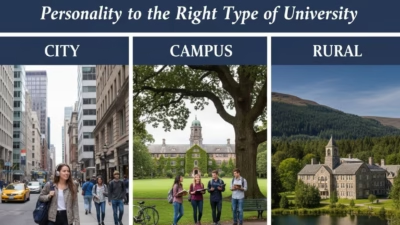
- City campus or quieter town.
- Easy transport links if you plan to go home often.
- Lifestyle:
- Do you want halls, a shared house, or to commute from home.
- Big, busy campus or smaller, close‑knit feel.
- Clubs, sports, societies, or a calmer place to study.
If you are honest about these limits, you avoid falling in love with an option that would always be a stretch for your budget or mental health.
Think about how you like to learn and study
Some courses suit students who love to read alone. Others suit people who enjoy labs, seminars, or group projects.
Ask yourself:
- Did you enjoy subjects with long essays, or short tests and problem sheets.
- Do you prefer clear right‑or‑wrong answers, or open questions and debate.
- Do you focus better in quiet, or with some buzz and group work.
Many flexible or generalist degrees use a mix of lectures, seminars, group projects, and independent study. That variety can help you work out how you learn best.
If you know you need support with planning and revision, it can help to build strong study habits before you go. You might find guides on effective exam study techniques useful while you think about your learning style.
Notice your interests and strengths without choosing a full career yet
You do not need a job title. You just need clues.
Look for patterns in what you enjoy:
- Do you like people‑centred tasks, such as mentoring friends or helping on school events.
- Do you enjoy problem solving, puzzles, or coding.
- Do you get lost in creative projects, like art, music, or design.
- Do you feel calm doing numbers and data, like Maths or spreadsheets.
- Do you prefer reading and writing, like English or History.
A quick journalling idea:
- Write three school tasks or hobbies you enjoyed.
- Under each, list why you liked it.
- Circle words that repeat, such as “helping”, “designing”, “organising”, “arguing my point”.
These clues will help you decide if you might enjoy:
- A joint honours degree that combines two strong interests.
- A single subject degree with some optional modules.
- A generalist or flexible course where you try different fields before choosing.
Keep these notes handy for later steps.
Step 2: Understand Your Main Options: Flexible, Joint Honours, and Generalist Degrees
Now you know more about how you like to live and study, it is time to look at the main course structures.
What is a flexible degree and why is it helpful if you are undecided?
A flexible degree gives you room to test different subjects before you commit.
Common set‑ups include:
- First year where you pick modules from several subjects, then choose a main subject in year two.
- “General entry” to a broad area like Arts, Social Sciences, or Science, then later sorting into a named degree.
- Systems where you can mix subjects across departments, as long as the timetable works.
You might see this in some Scottish courses, some liberal arts style programmes, and broad “arts and sciences” routes.
Pros of flexible degrees
- You can try new subjects without starting a whole new degree.
- It feels less risky if you are still unsure, since you keep choices open.
- You can mix areas, for example Psychology with a bit of Business or a language.
Cons of flexible degrees
- Less depth in one subject at the very start.
- Timetable planning can be tricky if you choose many areas.
- You need to make active choices later, which can feel stressful if you struggle with decisions.
If you like variety and feel anxious about “locking in”, flexible degrees can be a strong fit.
What are joint honours degrees and when do they make sense?
A joint honours degree means you study two main subjects at the same time, usually in a 50/50 split.
Examples include:
- History and Politics
- English and Philosophy
- Maths and Economics
- Psychology and Criminology
Both subjects appear in your final degree title.
This suits students who:
- Genuinely enjoy two subjects and do not want to drop one.
- Are happy to handle a busy timetable and two sets of reading or problem sheets.
- Like switching between different types of work in the same week.
Pros of joint honours
- You build skills and knowledge in two areas.
- You join two academic communities, which can help with friends and contacts.
- Your timetable feels varied.
Cons of joint honours
- Less time to go deep into each subject compared to single honours.
- Fewer spare credits for modules outside your two main areas.
- Managing deadlines for two departments can feel intense.
When you read course pages, look for answers to questions like:
- Can students change from joint honours to single honours after first year.
- Is there a way to move to a major/minor split, for example 75/25.
That flexibility can make joint honours feel safer if you are unsure which subject will win your heart.
What are generalist degrees and liberal arts style programmes?
Generalist degrees and liberal arts or liberal arts and sciences programmes stay broad for longer.
You usually:
- Study a range of subjects across arts, social sciences, and sometimes sciences.
- Take core modules that build skills like writing, research, and critical thinking.
- Choose a “pathway”, “concentration”, or “major” later, once you have tried different areas.
A week might include:
- A seminar on political ideas.
- A science skills workshop.
- A literature discussion.
- A project skills session.
Common assessments are essays, presentations, seminar contributions, and group projects.
These courses suit students who:
- Are curious about many subjects.
- Enjoy discussion and reading.
- Want broad skills that can apply to different careers.
The main trade‑off is that you spread your time across areas, rather than going deep into one subject from day one.
How single honours degrees work if you are still unsure
A single honours degree focuses on one subject, like English Literature, Biology, or Computer Science.
You might think this is only for people who are 100% sure. That is not always true.
Many single honours degrees:
- Offer optional modules from other departments.
- Let you choose different pathways inside the subject, such as human biology or ecology.
- Allow transfers between related subjects in the first year, for example from Physics to Physics with Astrophysics.
Single honours can work well if:
- You feel a strong pull toward one subject.
- You still want some choice in modules.
- You like the idea of being “based” in one department.
So do not rule them out just because you are undecided today.
Step 3: Compare Universities by How Much You Can Change Your Mind
Two degrees with the same name can feel very different. The key is not just what the course is called, but how much room it gives you to change direction.
Check how easy it is to switch courses or subjects in the first year
Many universities allow some movement in the first term or year, especially within the same department or faculty.
When you research, look for:
- Phrases like “flexible entry”, “undeclared”, “general entry”, or “choose your pathway later”.
- Statements about switching course, such as “students may transfer to related degrees in year one, subject to space”.
If the website is not clear, you can:
- Email admissions with a short, polite question.
- Ask at open days or virtual Q&A sessions.
- Note down any conditions, like grade requirements or limited places.
Keep a simple note for each university: “Easy to switch: Yes / Some / Hard”. This will matter a lot if you change your mind after arriving.
Look closely at module choice, not just course titles
Course titles can hide big differences.
When you open a course page, check:
- First year modules: Are most fixed, or are there options.
- Optional modules: How many can you choose, and from where.
- Specialisation: Do you choose a pathway in year two or three.
- Outside options: Can you take modules from other departments.
Imagine two “Psychology” courses:
- Course A: First year is almost all core Psychology, with one optional module in a related area.
- Course B: First year includes core Psychology plus two open options from subjects like Sociology, Philosophy, or a language.
Course B suits an undecided student more, even though both are called “BSc Psychology”.
Highlight courses where you can try at least two or three different areas in first year. Those go higher on the shortlist.
Compare how much support and guidance each university gives undecided students
Support matters a lot when you are not sure of your path.
Look for:
- Academic advisers or personal tutors who can help you choose modules and talk through changes.
- Careers service that offers drop‑ins, workshops, and advice for students without a clear plan.
- Study skills support, like workshops on essay writing, time management, or exam prep.
Good questions to ask on open days or live chats:
- “How do you support students who change course after they arrive.”
- “Is there guidance in first year for choosing modules and pathways.”
- “Do you run careers events for students who are not sure what they want yet.”
If a university seems kind, organised, and clear on this, it is a good sign for your well‑being and motivation.
Step 4: Build a Shortlist and Decide What Type of Course Fits You Best
By now you probably have many tabs open and a head full of options. This step is about turning that mess into a small, calm shortlist.
Use a simple comparison chart to rank your top options
You can use a notebook, spreadsheet, or even a whiteboard.
Create a table like this:
| University & course | Course type | Flexibility to switch | Module choice | Location fit | Cost fit | Gut feeling |
|---|---|---|---|---|---|---|
| Example: Uni A, Liberal Arts | Generalist / flexible | 5 | 5 | 4 | 3 | 5 |
| Example: Uni B, History & Politics | Joint honours | 3 | 3 | 5 | 4 | 4 |
Score each from 1 to 5, where 5 is “great for me”.
Treat the scores as a guide, not a rule. If something looks good on paper but feels wrong, listen to that feeling.
Match course types to your personality and goals
Use these simple profiles as a sense check:
- Flexible or generalist degrees: Good if you like many subjects, want time to explore, and hate the idea of being boxed into one path too soon.
- Joint honours: Good if two subjects excite you in the same way, and you feel ready for a full timetable.
- Single honours with options: Good if you have a favourite subject already, but still want a bit of variety and room to adjust in first year.
Read those three lines again and notice which one sounds most like you. That is often your best starting point.
Make a decision you can change later, not a decision for life
Your first degree choice does not lock in your whole life.
Many students:
- Change course after first year.
- Transfer to a different university.
- Go into jobs or postgraduate study that are not a neat match to their degree title.
Use a simple rule: if a course interests you, gives you room to explore, and fits your main needs, it is “good enough” to apply for.
Then take one next step:
- Book an open day or campus tour.
- Draft a personal statement for one course type.
- Talk your ideas through with a teacher, adviser, or trusted friend.
Action beats endless scrolling.
Frequently Asked Questions About Choosing a University When You Are Undecided
Is it bad if I start a degree and then change my mind?
No. Many students change course or direction. It might feel messy, but it is often better than staying on a course that makes you unhappy. The key is to know the rules on switching before you start, so you have options.
Will a generalist or liberal arts degree hurt my career chances?
Most employers care more about your skills, grades, and experience than your exact degree title. Generalist degrees often build strong skills in writing, analysis, and communication. You may need to explain your course clearly on your CV and in interviews, but it will not close doors by itself.
Can I apply to different course types at different universities?
Yes. You can apply for a mix, such as joint honours at one place, a flexible science degree at another, and single honours somewhere else. Just make sure your personal statement can cover the common themes between them, like your interest in people, data, or problem solving.
What if my parents want me to pick a “safe” subject?
Parents often worry about money and jobs. You can listen to their concerns, then share what you have learned about course types, skills, and career paths. A “safe” subject that you hate is not really safe. A better aim is a course you can stick with, where you will work hard and stay well.
Can I take a gap year instead if I feel too unsure?
Yes, a gap year can help if you use it with purpose. You might work, travel, or take short courses to test your interests. Just plan how you will keep up academic habits and deadlines, so the next application cycle feels easier, not harder.
Conclusion
You started with pressure to choose both a course and a university, even though you did not know what you wanted to study. Now you have a simple way to move forward.
You have looked at your needs, values, and limits. You understand the main course types, from flexible and generalist routes to joint honours and single honours with options. You know how to check each university’s real level of flexibility, not just the glossy headlines, and you have a clear method to build a small shortlist that fits you.
You do not need a perfect plan at 18. You just need a course that feels interesting, gives you room to explore, and sits within your money, location, and lifestyle limits. Stay curious, use your time at university to test ideas, and trust that you can build a path that suits you, even if you are undecided right now.