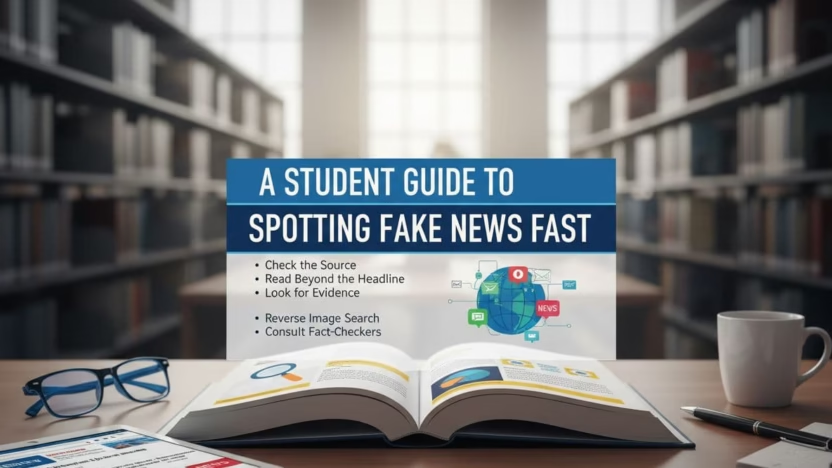
Fake news spreads faster than your group chat on exam day. One wrong screenshot, one dodgy headline, and suddenly everyone “knows” something that is not true at all.
As a student, you need to spot fake news fast. It affects essays, presentations, debates, and even how you vote in the future. The good news is that fact-checking is a skill, not a talent. You can learn it, practise it, and get quick at it.
This guide walks you through simple steps, tools, and habits that turn you from an easy target into a smart, confident fact-checker.
Key Takeaways
- Slow down before you share. If something makes you angry or shocked, that is your first warning sign.
- Always check the source. Look at who published it, their purpose, and their reputation.
- Cross-check with trusted outlets and fact-checking sites. Never rely on a single link or screenshot.
- Look at evidence, not just opinions. Good articles show data, quotes, and clear references.
- Build small habits. Two minutes of checking now can save you from spreading lies later.
Table of Contents
- Key Takeaways
- Why Fake News Hooks Students So Easily
- A Simple 5-Step Process To Spot Fake News Fast
- Quick Tools And Websites For Fact-Checking
- Build Daily Habits That Make Fact-Checking Easy
- Conclusion: Be The Person Who Pauses Before Sharing
- Frequently Asked Questions About How To Fact-Check Like A Pro
Why Fake News Hooks Students So Easily
Fake news is like junk food for your brain. It is designed to be quick, tasty, and addictive, not healthy.
You are a perfect target if you are tired, scrolling fast, or cramming. Your brain wants shortcuts, not deep thinking. Emotional headlines, memes, and short clips feel easier to process than long, careful articles.
Many fake or misleading stories use:
- Strong emotions (anger, fear, pride)
- Simple “good vs evil” stories
- Claims that “they” are hiding the truth
That is why a bold headline can feel more convincing than real research. Knowing this helps you pause and think, “Is this pushing my feelings, or giving me facts?”
For a simple student-friendly visual, you can look at this fake news infographic from Cornell University Library, which breaks the problem into clear checks.
A Simple 5-Step Process To Spot Fake News Fast
You do not need a journalism degree. You just need a short routine you can repeat every time something looks suspicious.
1. Check the source before anything else
Treat every link like a stranger at your front door. Who are they and what do they want?
Ask yourself:
- Have I heard of this website before?
- Is it a real news outlet, a personal blog, or a parody site?
- Does it have contact details, an “About” page, and clear ownership?
The CSI Library’s guide on how to spot fake news suggests checking the site’s mission and background. If a page hides who runs it, be extra careful.
If the story is only on one unknown site, and nowhere else, that is a warning sign.
2. Read beyond the headline
Headlines are bait. They are written to grab attention, not to tell the full truth.
Before you react or share:
- Read the whole article, not just the title or the first line.
- Watch for exaggerated language like “shocking”, “secret truth”, or “the media will not tell you this”.
- Check if the body of the article actually matches the headline.
Sometimes the headline sounds angry or dramatic, but the article itself is far more balanced, or even says the opposite.
3. Look for evidence, not just opinions
Real reporting shows its work. Fake or low-quality content often skips proof and jumps straight to strong claims.
Look for:
- Named experts, not “a scientist” or “a doctor” with no details
- Links to original studies or official reports
- Clear dates and locations
- Direct quotes you can search for elsewhere
Compare that to a weak article, which might have:
- No sources or only one unnamed source
- Out-of-context screenshots with no link to where they came from
- Old photos used for a new story
You can also see how youth-focused sites explain this. For instance, National Geographic Kids has a guide on how to spot fake news that shows simple checks in a friendly way.
4. Cross-check with reliable outlets
One site can make a mistake. When several independent outlets report the same thing, the chance of it being true is much higher.
To cross-check:
- Search the main claim in a new tab, not from the link you were sent.
- Include keywords like “BBC”, “Reuters”, or “AP” with your search.
- Check dates so you are not mixing an old story with a new claim.
If a story is truly huge but only appears on a random TikTok or one unknown website, something is probably off.
5. Use fact-checking websites
Fact-checking sites do the heavy lifting for you. They collect rumours and viral claims, then investigate them.
You can keep a small list of go-to sites, such as:
- The list of checked outlets on CSI’s fact-checking websites page
- Collections of tools in the Berkeley Library guide to fact checkers
- Broader lists like the Wikipedia page of fact-checking websites
Type a short version of the claim into these sites. Often, if something has gone viral, they have already investigated it.
Quick Tools And Websites For Fact-Checking
You do not need fancy software. A few free tools in your browser are enough.
Reverse image search:
Upload or paste an image into Google Images or TinEye. If the same photo appears in old stories, different countries, or totally different contexts, you know someone is reusing it in a misleading way.
Date and location checks:
Look at the date on the article, not just when it appeared on your feed. Many fake posts use old disasters or protests to stir up new anger. If a dramatic event only appears in old news, the post you saw might be reusing content.
Misinformation guides for young people:
Organisations like UNICEF offer clear advice on rumours, hoaxes, and propaganda. Their quick guide to spotting misinformation explains the difference between simple mistakes and harmful disinformation.
Teacher-focused resources:
If you are interested in how schools teach this, the NEA has ideas in its article on helping students spot misinformation online. You can adapt some of the exercises for your own study group.
Build Daily Habits That Make Fact-Checking Easy
Fact-checking should feel like washing your hands, not a research project. Small habits make it automatic.
Try these simple rules:
- “Pause and Google” rule: If a post shocks you, you must search it before sharing.
- Two-source rule: You need at least two independent, reliable sources before you treat something as true.
- Saved tools folder: Keep a bookmark folder in your browser called “Fact-checking” with your favourite sites.
- Group norm: Agree with friends that you will call out fake news in the group chat without mocking each other.
You will start to feel the difference. After a while, your brain notices red flags faster and you spot fake news in seconds.
Conclusion: Be The Person Who Pauses Before Sharing
Fake news feeds on speed. Fact-checking feeds on that tiny pause where you decide to think.
As a student, you already know how to question sources for essays. You are simply applying the same skills to your phone, your group chats, and your social feeds. With a clear process, a few trusted tools, and daily habits, you can protect yourself and others from misinformation.
Next time something shocks you, treat it as a challenge: can you prove it before you pass it on?
Frequently Asked Questions About How To Fact-Check Like A Pro
How can I spot fake news fast without spending ages on it?
Use a quick three-step check: look at the source, scan for evidence, then search for the same story on a trusted outlet. Most fake news fails one of these checks in under a minute.
What are the best fact-checking sites for students?
Start with general fact-checking collections, like the ones listed in the Simpson Library guide to fact-checking websites. From there, pick a few you like and bookmark them. You do not need dozens, just a solid handful.
Is it rude to tell friends they shared fake news?
It depends how you do it. Focus on the information, not the person. You can say something like, “I checked this and it seems the photo is from 2012, not from this week.” Offer a link to a fact-check so they can see for themselves.
How can I use fact-checking in my school or university work?
Use the same checks you apply to social media for your essay sources. Check who wrote the article, how recent it is, and what evidence it uses. Teachers are impressed when you can explain why a source is reliable, not just when you add more quotes.
What should I do if I realise I already shared fake news?
Correct it as soon as you can. Delete the post if possible, and share a follow-up message with a reliable link. Admitting a mistake shows honesty and helps stop the false story from spreading further.