A “leaked” phone call hits your group chat, everyone’s reacting, and the clip feels real. The voice sounds right. The emotions sound right. The stakes can feel huge, especially when it’s about a school, a local event, or a public figure.
But audio is easy to misread. A 12-second voice note is like a screenshot of a whole conversation, it can be cropped, edited, or faked, and you’d never know from vibes alone. If you want to verify viral audio, you need a calm, repeatable method.
Key Takeaways
- Provenance beats volume: who posted it, where it first appeared, and whether the original file exists matters most.
- Short clips often hide the truth, push hard for the full recording and context.
- Listen for edits and background changes, not just the words.
- Cross-check with trusted reporting and official statements before sharing.
- Use quick, basic forensics (metadata, waveform, spectrogram) and treat detector tools as clues, not proof.
Table of Contents
- Key Takeaways
- A simple workflow to verify viral audio (use this every time)
- Start with the original: provenance beats “it sounds real”
- Find the missing context: earliest upload, full clip, and transcript
- Listen like an editor: cuts, room tone, and weird timing
- Cross-check the claim, not just the clip
- Use basic audio forensics (and treat detectors as clues)
- Decide what to share (and how to say it)
- Conclusion
- Frequently Asked Questions About Verifying Viral Audio Clips
A simple workflow to verify viral audio (use this every time)
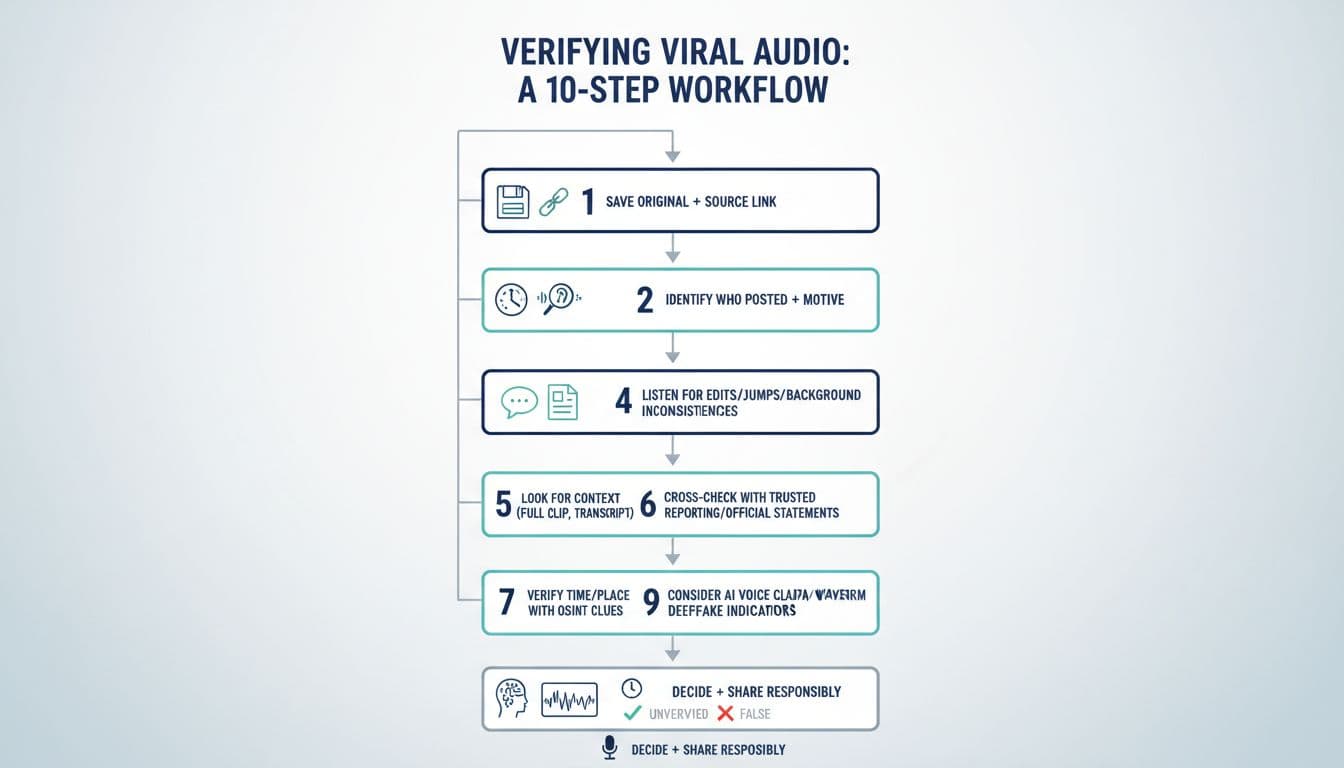
When an audio clip goes viral, people rush to judge the content. You’ll get better results by judging the container first: where it came from, how it travelled, and what might have been cut out.
A good routine is: save the best version you can, trace the earliest upload, check the poster’s motives, test the audio for edits, then check the claim against reliable sources. Only after that should you think about deepfake possibilities.
Start with the original: provenance beats “it sounds real”
If you only do one thing, do this: try to find the original file and the earliest source. Reposts on TikTok, Instagram, and X often re-encode audio, stripping details that help verification.
Practical steps that work for students:
- Save the post link and take screenshots of the caption, date, and account.
- Ask: Who recorded this? If the answer is “someone sent it to me”, treat it as unverified.
- If it came through WhatsApp or Telegram, request the first version that entered the chat, not the fifteenth forward.
If this clip could harm someone’s reputation, your default stance should be: “interesting, but unproven”.
Find the missing context: earliest upload, full clip, and transcript
Viral audio thrives on missing context. A real recording can still mislead if it’s trimmed.
Try this:
- Search for the earliest upload and compare versions. If different accounts have different lengths, that’s a sign you’re not seeing the whole thing.
- Look for a full recording or a longer cut. If the claim depends on one spicy sentence, it’s almost always missing the set-up.
- Write a quick transcript yourself. Reading the words often highlights what’s unclear, like missing names, missing dates, or vague “they” references.
A useful reality check is to look up cases where “leaks” were debunked after people got carried away. For example, FactCheck.org’s write-up of a phony “leaked” audio clip shows how quickly a convincing clip can spread before basic checks catch up.
Listen like an editor: cuts, room tone, and weird timing
Most misleading audio isn’t Hollywood-level fake. It’s often edited.
Put headphones on and listen for:
- Jumps in background noise (a café hum suddenly disappears, then comes back).
- Unnatural pauses that feel like a sentence was stitched together.
- Volume or distance shifts, as if the speaker moved rooms mid-word.
- Over-clean audio for a “secret recording”, where there’s no hiss, no room sound, no phone mic quirks.
Here’s a quick guide to common red flags:
| What you notice | What it can mean | What to do next |
|---|---|---|
| Background changes mid-sentence | Splice or different takes | Find a longer version, compare copies |
| Sudden tone shift in the voice | Edit point or inserted phrase | Listen for repeated words or clipped breaths |
| Audio sounds too clean for a phone | Heavy processing or synthesis | Run basic forensics checks |
If you want a deeper list of warning signs, this breakdown of deepfake audio red flags and checks is a useful reference point.
Cross-check the claim, not just the clip
A clip can be authentic and still tell a false story. So check the claim like you would check a rumour about an exam date.
Do three quick checks:
- Trusted reporting: Have reputable outlets covered it, or is it only circulating on social posts?
- Official statements: Has the person, school, or organisation responded?
- Motive: Who benefits if people believe this audio right now?
This also links to a bigger question about how misinformation spreads and who should deal with it. If you’re exploring that angle for class or debate practice, Should social media platforms be held liable for the spread of misinformation? is a solid starting point.
For a clear explanation of how audio deepfakes work and why they can fool people, Deutsche Welle’s fact check on spotting audio deepfakes is also worth reading.
Use basic audio forensics (and treat detectors as clues)
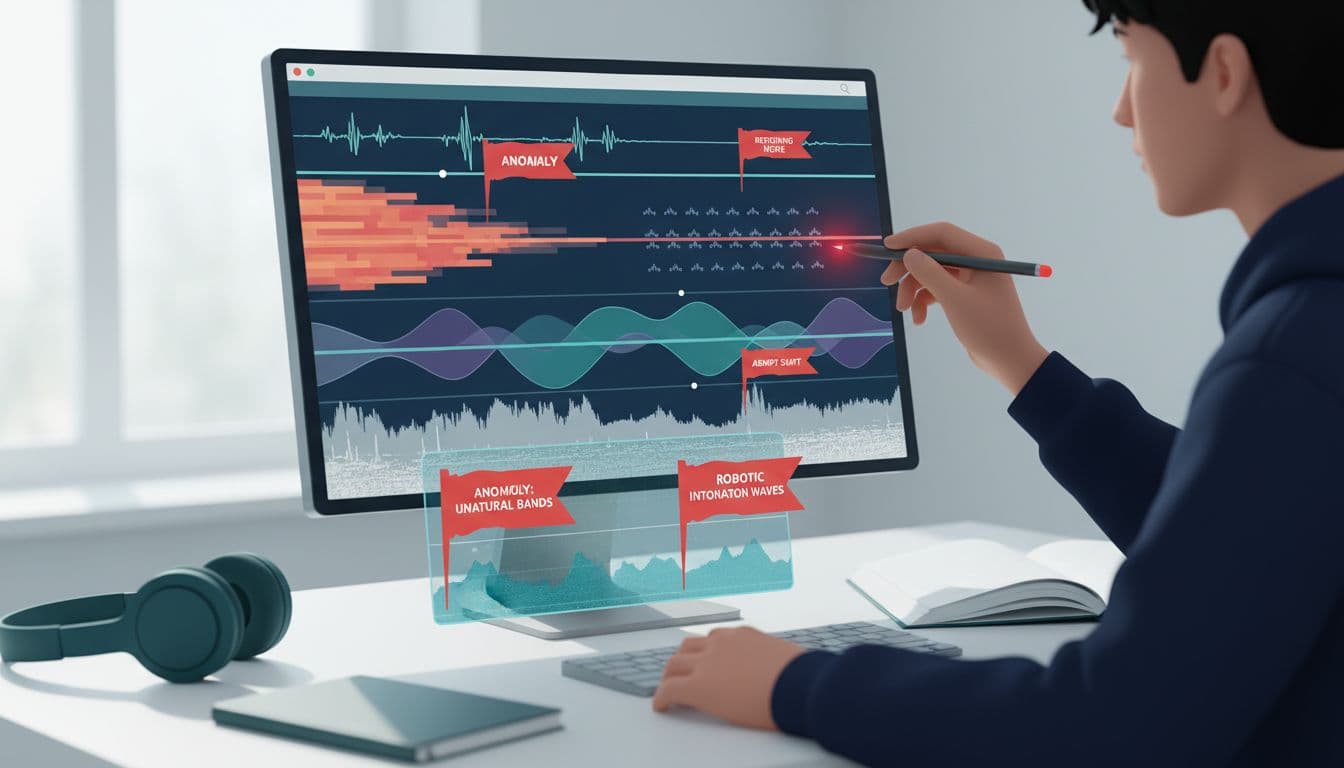
In December 2025, detection tools are faster, but they still miss new fakes. The safest approach is layered checks: source, context, listening tests, then technical checks.
Student-friendly forensic checks:
- Metadata: On your phone or laptop, view file info (date created, app used, format). A mismatch (like a “voice note” tagged with desktop editing software) is a strong clue.
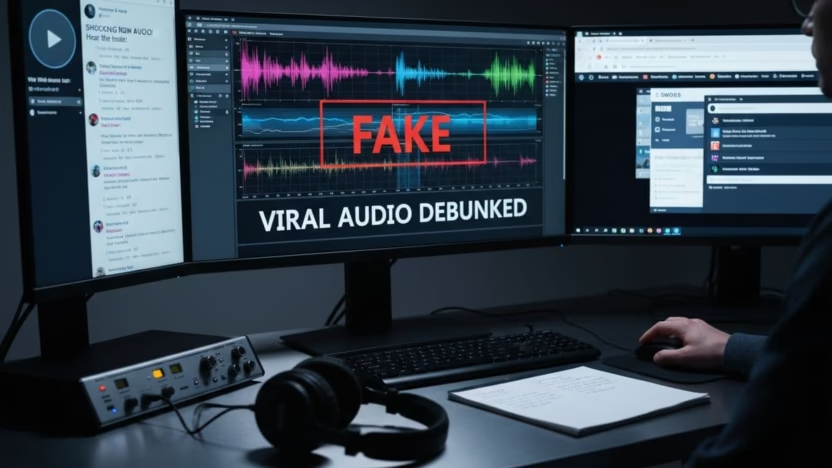
- Waveform and spectrogram: Free audio editors can show abrupt cuts or odd repeating patterns. You’re not proving anything alone, you’re looking for “this needs more proof”.
- Multi-tool scans: If you use AI detectors, use more than one and compare results. Tools mentioned in current reporting and industry use include Resemble AI, Sensity, McAfee Deepfake Detector, and Reality Defender, but treat outputs as probabilities, not verdicts.
For a more investigative, journalist-style checklist, the GIJN tipsheet on investigating AI audio deepfakes is packed with practical ways to think about evidence.
Decide what to share (and how to say it)
When you can’t confirm it, don’t turn your repost into “proof”.
A safe sharing standard:
- Use labels like unverified or unconfirmed.
- Share the question (“is this real?”), not the accusation (“this proves…”).
- Don’t post doxxing details, even if you’re angry.
- If it’s high-stakes (legal threats, public safety, election claims), stop sharing and preserve the file plus the source trail.
Conclusion
Viral audio works because it feels personal, like you’re overhearing the truth. But to verify viral audio, you need evidence, not instinct. Save the best version, find the first source, check context, listen for edits, and cross-check the claim with reliable reporting. If the proof isn’t there, treat the clip as a rumour, and share accordingly.
Frequently Asked Questions About Verifying Viral Audio Clips
How can I tell if a leaked phone call is real?
Start with provenance. Ask for the original file and trace the earliest upload. Then listen for edit points and check if trusted sources confirm the context. “Sounds real” isn’t a verification method.
What’s the biggest red flag in a voice note?
A clip with no clear source and no longer version is the biggest warning sign. Technically, abrupt background changes and odd timing can also suggest edits.
Do AI deepfake detectors prove an audio clip is fake?
No. In 2025, detectors can flag likely synthesis, but new tools and heavy compression can fool them. Use detectors as one clue among source checks, context checks, and audio inspection.
Should I share the audio if I’m not sure?
If you must mention it, describe it as unverified and avoid repeating the most damaging claim. If it could harm someone, don’t spread it until you have solid corroboration.