
 Paul Scott

Harvard referencing uses brief author-date citations within your essay and full source details in an alphabetical reference list. Each citation tells your reader whose work supports your point and where to find it.
The main challenge is consistency: Harvard has several university-specific versions, with different punctuation and formatting rules. Start with your prescribed version, then build each citation alongside its matching reference.
Key Takeaways
- Cite borrowed ideas, findings and wording, including material you’ve paraphrased.
- Include page numbers for direct quotations and precise passages where your university requires them.
- Match every in-text citation to a complete reference, using your university’s Harvard variant throughout.
Start With Your University’s Harvard Style
Harvard is a family of author-date systems rather than one universal rulebook. Your department might prescribe Cite Them Right Harvard, Leeds Harvard or another local version.
The Open University’s Harvard guide{target=”_blank” rel=”nofollow”} follows Cite Them Right. Harvard citation format can differ between university guides, including rules for author limits, publication places and access dates.
Despite its name, Harvard referencing wasn’t officially created as a style by Harvard University. Its early parenthetical citation history is commonly traced to Harvard zoologist Edward Laurens Mark.
The patterns below are common conventions. Your prescribed Harvard style takes priority where details differ.
Write In-Text Citations Correctly
Cite Authors and Paraphrased Ideas
Place the parenthetical citation (the in-text citation) after the relevant wording and before the full stop:
People often rely on rapid judgements (Kahneman, 2011).
You can also name the author within the sentence: Kahneman (2011) discusses rapid judgements. This is a narrative citation.
These illustrative patterns show how author numbers affect citations:
| Authors | Common In-Text Format |
|---|---|
| One | (Smith, 2020) |
| Two | (Smith and Jones, 2020) |
| Three | (Smith, Jones and Taylor, 2020) |
| Four or more | (Smith et al., 2019) |
Keep authors in their published order. Use and, rather than an ampersand, for two authors in these examples. For multiple authors, follow your university guide on when to shorten the author list. Some Harvard variants introduce et al. at three authors instead.
A paraphrase still needs an in-text citation. Recast the meaning in your own sentence structure; changing a few words does not make the idea yours.
Add Locations for Quotations
A direct quote needs a locator, including a page number: (Kahneman, 2011, p. 406). Use p. for one page and pp. for a range, such as pp. 406-407.
Place the citation outside the closing quotation mark but before the sentence’s final punctuation. When a citation precedes a comma, the comma follows its closing bracket.
For unpaginated webpages, use a numbered paragraph or named section where your guide permits it, for example (Organisation, Year, para. 4). Don’t invent page numbers.
Page numbers also help readers locate detailed paraphrases. Cite borrowed statistics, theories and arguments, but you don’t normally need references for common knowledge.
Handle Missing Details and Repeated Authors
Use Organisations, Titles and No-Date Markers
An organisation can be the author: (World Health Organization, 2022). Don’t replace a named individual with the website’s owner simply because its logo appears prominently.
If neither an individual nor an organisation is responsible, use the title. One common pattern puts an article title in single quotation marks: ('Divest', 2020).
Where no publication date appears, use your prescribed marker. A common form is (Scribbr, no date), with (no date) repeated in the reference entry. Online references can still require an access date.
Check the source for its year of publication; a website’s general copyright year doesn’t necessarily date an individual page.
Distinguish Works Published in the Same Year
For different works by the same author in one year, add lowercase letters: (Smith, 2021a; Smith, 2021b).
Repeat those letters in the reference list. Assign them using your guide’s ordering rule, often alphabetical order by title.
For the same author across different years, arrange entries chronologically, usually earliest first. However, don’t rearrange the co-authors within any individual entry.
Build the Citation and Reference List Together
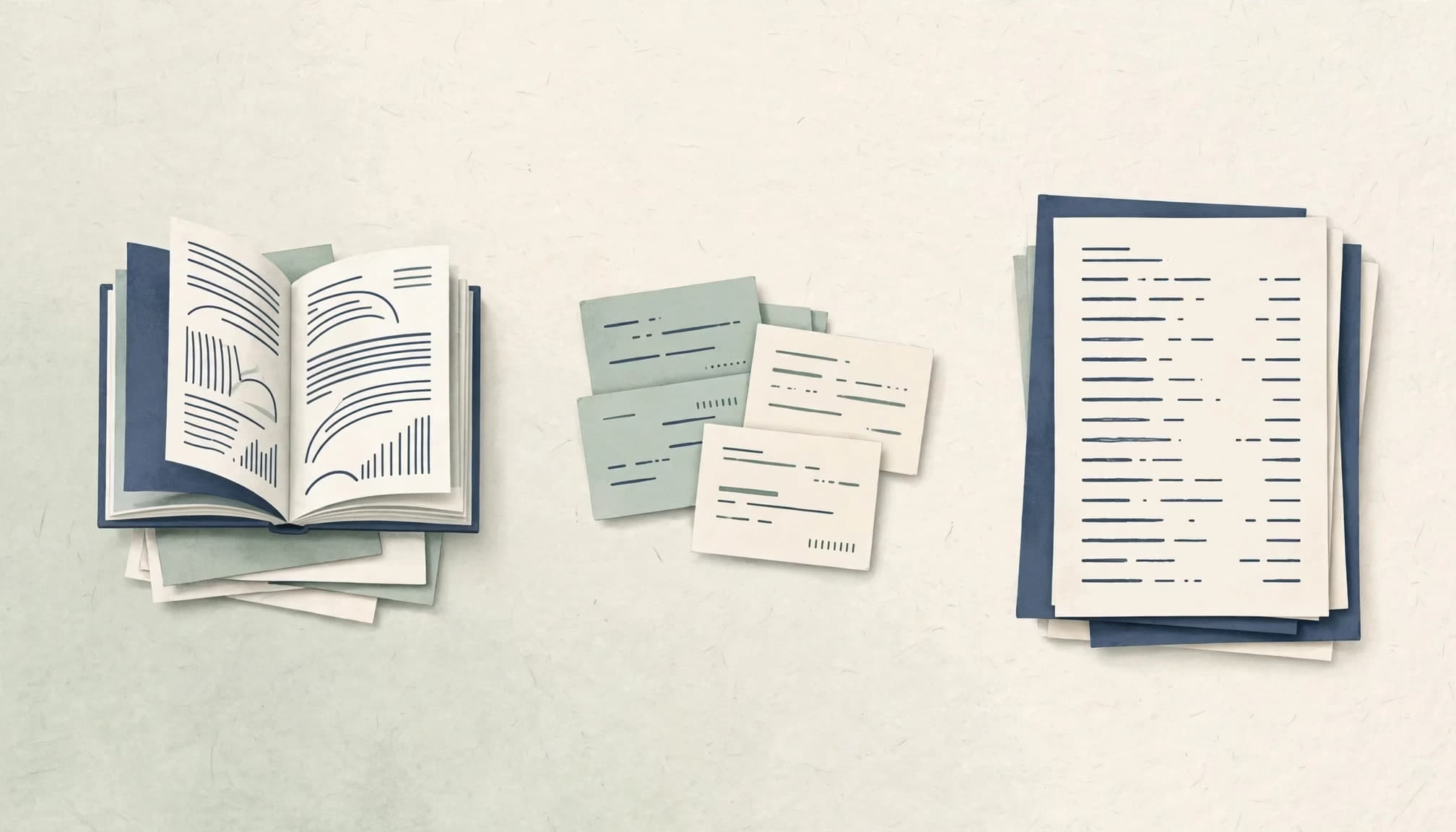
Start a section headed References, normally on a new page. Arrange entries alphabetically by the first author’s surname or the organisation’s name.
A reference list contains works cited in your essay. A bibliography may also include background reading, depending on the assignment.
Reference-list author limits vary too. Some versions permit Smith, T. et al. (2014); others require every author.
Record publication details and page numbers whilst reading. Our guide to taking notes from academic papers helps you keep quotations separate from your own summaries.
A citation generator can format incomplete information neatly. It can’t supply missing details reliably.
Match Each Reference to Its Source

Books and Ebooks
A common print-book template is:
Surname, Initial. (Year) Title. Edition. Place: Publisher.
For (Kahneman, 2011), the matching reference is:
Kahneman, D. (2011) Thinking, fast and slow. New York: Farrar, Straus and Giroux.
Include an edition only when relevant, such as 2nd edn.; don’t label a first edition as a second.
For an ebook, follow the equivalent book pattern, adding a DOI, platform or URL where your variant requires it. Use stable printed page numbers when available, rather than device-dependent location numbers.
Online Journal Articles
A common online-article template is:
Surname, Initial. (Year) ‘Article title’, Journal Title, volume(issue), pp. page range [online]. Available at: DOI or URL (Accessed: Day Month Year).
For example, (Roediger and Karpicke, 2006) refers to:
Roediger, H.L. and Karpicke, J.D. (2006) ‘Test-enhanced learning: Taking memory tests improves long-term retention’, Psychological Science, 17(3), pp. 249-255.
The Leeds online journal guidance{target=”_blank” rel=”nofollow”} requires online details, including a DOI where available. Where your guide requires the [online] label, retain it in square brackets. Other variants omit the label or access dates for DOI-linked articles.
Websites
Use: Author (Year) Page title. Available at: URL (Accessed: Day Month Year).
For (UCL, no date), a worked entry is:
UCL (no date) Harvard: References with missing details. Available at: UCL’s missing-details guidance{target=”_blank” rel=”nofollow”} (Accessed: 20 October 2026).
Use the individual page title, not merely the website name, and record your own access date.
Reference Media, Downloaded Files and Datasets
Blogs, Newspapers and Social Posts
Blog and newspaper article titles commonly take single quotation marks, while the publication name takes italics. Add the publication day and month.
For (Rakich, 2020), the core reference is:
Rakich, N. (2020) ‘How does Biden stack up to past Democratic nominees?’, FiveThirtyEight, 28 April.
For an online version, add the URL and access date required by your guide.
Social media references often include the username in square brackets. The author element might read Dorsey, J. [@jack] (2018), followed by the post text in single quotation marks, platform, posting date and URL. Cite it as (Dorsey, 2018).
Videos and Podcasts
Use timestamps to locate particular moments, such as (Scribbr, 2020, 1:58) or (Carlin, 2017, 25:55).
A useful video template is:
Creator (Year) Video title [Online video]. Available at: URL (Accessed: Day Month Year).
For podcasts, use:
Creator (Year) ‘Episode title’, Podcast title, Day Month [Podcast]. Available at: URL (Accessed: Day Month Year).
Keep format descriptors such as [Online video] and [Podcast] in square brackets if your university’s guide requires them.
PDFs, Word Documents and Datasets
A file format doesn’t determine the reference type. Cite a downloaded journal PDF as a journal article and a report saved as a Word document as a report.
Similarly, cite the original publication rather than your library database’s search-results page. Prefer a DOI or stable source link over a temporary login URL.
For datasets, record the creator, year, title, version, repository and DOI or stable URL. Include a [Dataset] description where your variant requires it.
Use AI and Reference Managers Responsibly
ChatGPT can suggest Harvard formatting, but it can also invent authors, titles, page numbers and DOIs. Base references on sources you’ve opened and read.
If AI suggests an Office for National Statistics report, cite that report after reading it. Don’t treat the chatbot’s summary as scholarly evidence.
AI acknowledgement and citation are separate requirements. UCL’s generative AI guidance{target=”_blank” rel=”nofollow”} distinguishes permitted tool use from situations where AI output itself needs referencing.
There isn’t one universal Harvard AI entry. The University of the West of Scotland gives this example:
OpenAI ChatGPT (2025) ChatGPT response to David Gallagher, 16 June.
Where AI use is permitted, retain prompts, relevant outputs, the tool name and dates. Apply your assessment’s declaration requirements.
Zotero, EndNote and other reference managers reduce repetitive formatting. Select the named university style, then review imported metadata against the original publication.
Frequently Asked Questions About Harvard Referencing
Is APA the Same as Harvard?
No. Both use author-date citations, but their punctuation and reference details differ. APA commonly uses & between authors in bracketed citations, whilst many Harvard variants use and. An APA reference isn’t automatically acceptable for a Harvard assignment.
How Do I Know Whether a Website Is Reliable?
Look for an identifiable author, relevant expertise, supporting evidence and a publication or update date. Consider the organisation’s purpose too. An official statistics release supports numerical claims more directly than an unsourced summary. A correct reference doesn’t make weak evidence reliable.
Does One Citation Cover a Whole Paragraph?
Only when the source attribution stays clear. A citation at the paragraph’s end can leave readers unsure which earlier claims it supports. Introduce the source early, then repeat citations when you change sources or the attribution becomes ambiguous.
Finish With References Your Reader Can Follow
Harvard referencing works when every borrowed idea has a clear source and every citation leads to a complete entry.
Before submitting, match citations against your reference list in both directions. Then review author names, dates, locators and formatting against your prescribed variant.
Accurate references make your evidence traceable and keep your own argument distinct from the work supporting it.