
 Paul Scott
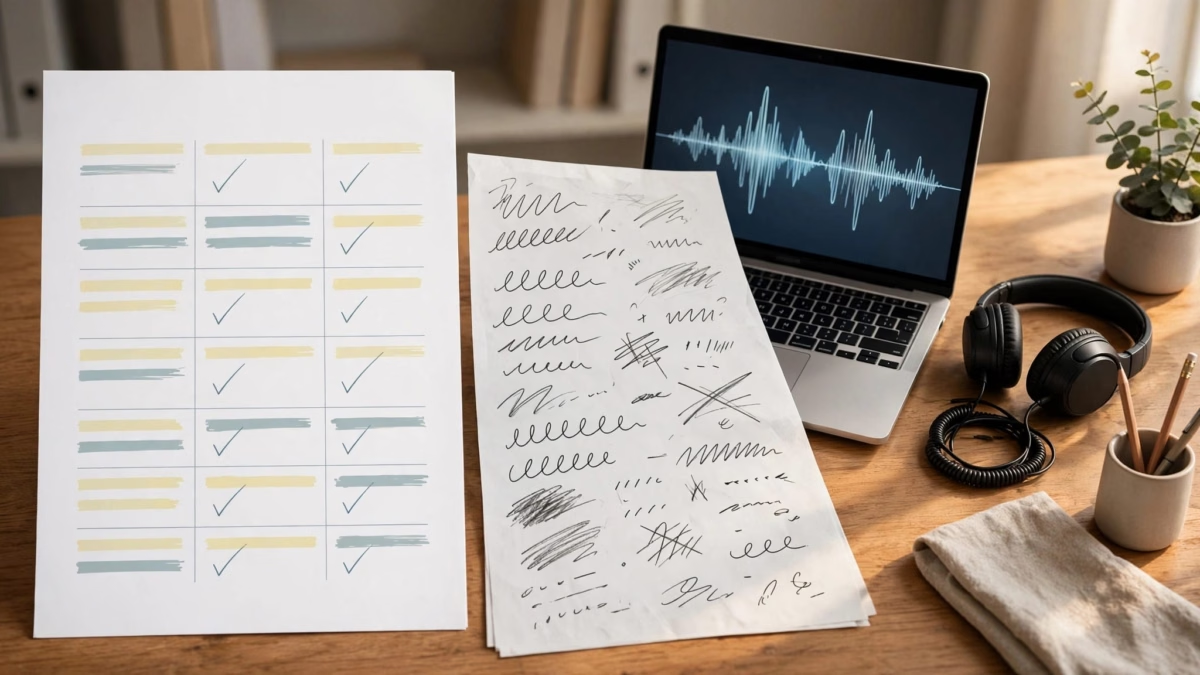
For an interview, choose intelligent verbatim transcription when your dissertation examines what participants say. Retain fuller speech detail when pauses, repetitions or interaction help answer your question. The choice should follow your analytical purpose, rather than whichever transcript looks tidiest.
Removing every hesitation can erase uncertainty, whilst recording every breath can create unnecessary work. Start by deciding which features of speech your analysis needs to preserve.
Key Takeaways
- Intelligent verbatim removes distracting fillers whilst preserving participants’ words and meaning.
- Strict verbatim retains hesitations and false starts; conversation analysis requires more systematic interactional detail.
- Agree conventions before transcribing, protect identifying information, and check every transcript against its recording.
Compare the Three Dissertation Transcription Styles
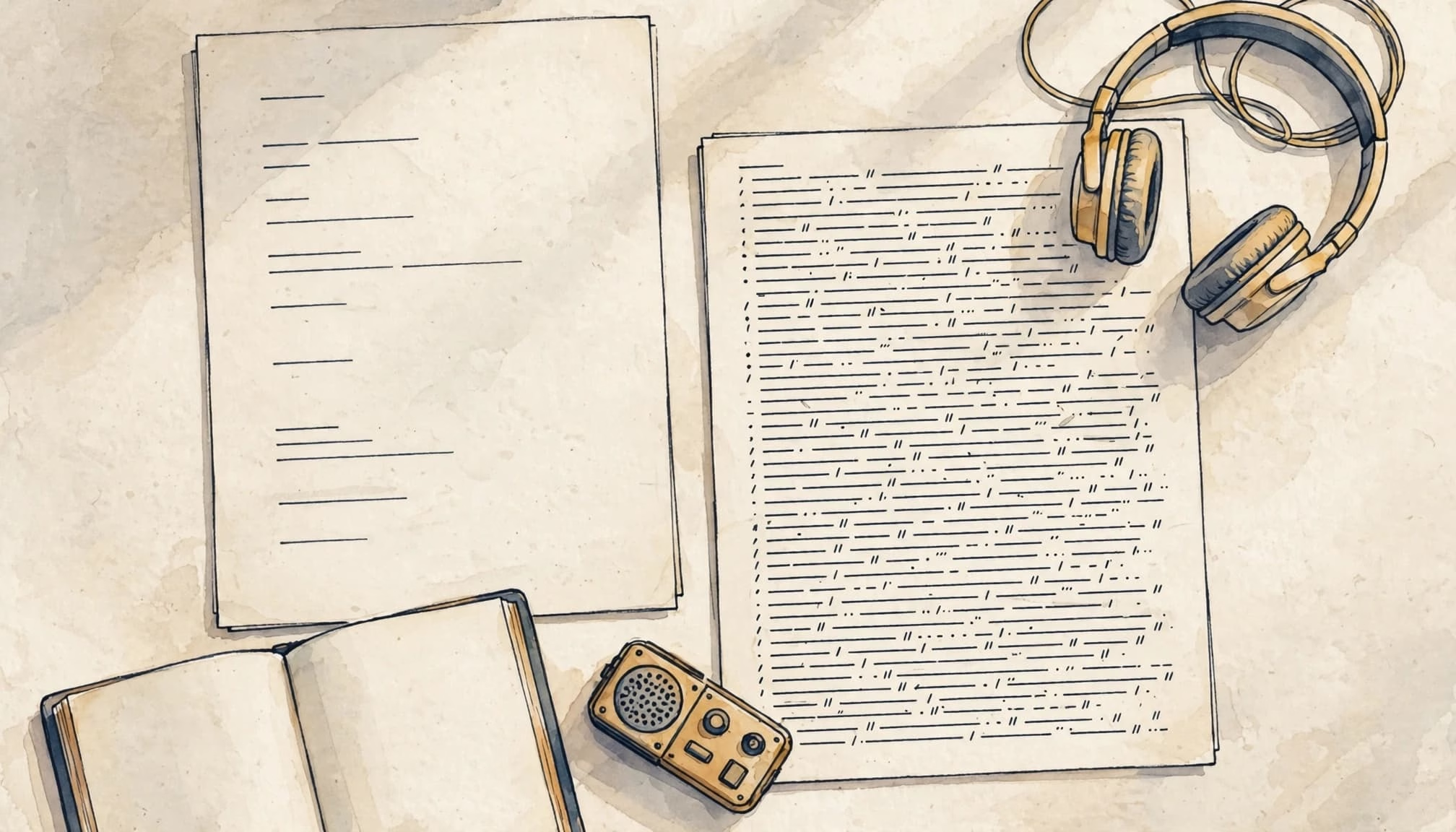
Audio transcription involves choices about what counts as evidence. Bucholtz’s discussion of transcription describes a spectrum for verbatim transcription. The readable end is called naturalized (spelled naturalised in UK English), while the other end retains more features of spoken interaction. Intelligent and full verbatim broadly occupy these different ends.
Intelligent Verbatim
Also called clean transcription, this removes non-meaningful fillers, accidental repetitions and abandoned starts. However, it preserves substantive wording, qualifications and contradictions. Don’t rewrite participants’ grammar or replace their vocabulary with academic language.
Strict Verbatim
Strict or full verbatim retains fillers, repeated words and incomplete sentences. It also records relevant audible events, such as laughter or pauses, according to your conventions. This makes delivery available for analysis, although it increases reading and transcription time.
Discourse or Conversation Analysis
Discourse analysis and conversation analysis (CA) aren’t interchangeable methods. However, both may require detail that ordinary verbatim misses. CA often uses systematic notation for overlap, timed pauses, stress and intonation.
These notation fragments illustrate differences without inventing participant quotations.
| Speech Feature | Intelligent Verbatim | Strict Verbatim | CA-Style Detail |
|---|---|---|---|
| Non-meaningful filler | Usually omitted | Retains “um” | Retains it within the interaction |
| Audible pause | Retained when meaningful | May use [pause] | May time it as (2.0) |
| Laughter | Included when relevant | Records [laughs] | Records placement and relationship to speech |
These are starting points, not universal specifications. A transcription notation key should define each symbol and convention you use.
Match the Detail to Your Research Question
Choose the minimum detail that preserves the evidence your analysis requires. More notation doesn’t automatically produce stronger research.
Thematic Analysis and Grounded Theory
Intelligent verbatim often suits qualitative research into experiences, beliefs and processes. For example, thematic analysis usually needs accurate accounts with enough surrounding context to interpret each passage.
However, grounded theory and thematic analysis aren’t automatic instructions to delete hesitation. Retain it when uncertainty, self-correction or emotional difficulty matters. Our guide to thematic analysis of dissertation interviews explains how coding develops into patterns across the dataset.
For Braun and Clarke’s reflexive approach, familiarisation and analysis are recursive. Later interpretations may send you back to a recording.
Language and Interaction Studies
Use fuller transcription when your question concerns how participants construct identities, resist questions or manage disagreement. Conversation analysis requires attention to sequential interaction, including interviewer contributions.
Pilot your choice on a short section, then attempt your intended analysis. Our guidance on piloting dissertation interviews includes testing recording and analytical procedures together. Record any changes to your transcription rules before applying them across the dataset.
Set Transcript Conventions Before You Start
A brief interview transcription guide prevents inconsistent decisions across interviews. Set rules for speaker turns, timestamps and nonverbal sounds, then apply the notation key across all dissertation transcripts.
Label Speakers and Locate Uncertainty
For clear speaker identification, start each turn on a new paragraph. Use consistent identifiers, such as Intvr: and Resp:, throughout. For multiple participants, assign stable identifiers such as P01: and P02:.
Use [...] for missing speech and [bribery?] when you think you heard “bribery” but remain uncertain. Add a timestamp, such as [00:05:34], so you can return to that point.
Define your convention because ellipses can otherwise mean either missing audio or editorial omission. Never silently guess an unclear word.
Preserve Meaning Without Guessing Emotions
Record observable sounds, such as [laughs], rather than interpretations such as [embarrassed]. Put your interpretation in an analytical memo.
Similarly, audio alone cannot establish that someone nodded or smiled. Record visual observations in linked field notes, or use video where consent and your method permit it.
Removing a repeated word is an analytical decision when that repetition changes emphasis, uncertainty or disagreement.
The UK Data Service’s transcription guidance supports consistent preparation and explicit transcription conventions.
Format the File and Add a Cover Sheet
Layout should support your analysis, rather than imitate a published interview.
Prepare for Paper Coding or Software
For paper coding, use wider margins and spacing-and-a-half to leave room for annotations. For software, choose a transcript format with flowing text and consistent speaker paragraphs, rather than decorative tables.
For transcription software workflows, NVivo and ATLAS.ti (Atlas-ti) have different import procedures, particularly for transcripts synchronised with media. NVivo’s autocoding can use Heading 1 styles to create codes. Don’t apply that style casually to every speaker label.
Import one short transcript first. Check speaker boundaries, timestamps and formatting before preparing the complete collection.
Keep a Restricted Interview Cover Sheet
Use a separate cover sheet to connect the interview with its supporting records. Keep identity-bearing metadata outside copies intended for sharing.
This layout records the main information without adding it to every transcript page.
| Field | Information to Record |
|---|---|
| Interviewee and pseudonym | Real identity in the restricted record; assigned participant identifier |
| Interviewer | Person who conducted the interview |
| Date, Time and Location | Interview timing, setting and remote platform where relevant |
| Audio File | Filename, duration and approved storage location |
| Related Records | Links to field notes and follow-up transcripts |
Add the transcript version and transcription conventions used. This helps you distinguish a corrected file from an earlier draft.
Protect Identities and Control Uploads
An interview transcript can remain identifiable after you remove the participant’s name. A rare job title combined with a small workplace may identify someone immediately.
Separate Originals From Working Copies
Keep an access-restricted original containing real names during analysis where your approved procedure permits it. Use pseudonymised working copies wherever possible.
Before publication, anonymise names, organisations and locations. This process is called anonymization in US English, and anonymisation in UK English. Replace identifying details consistently without removing context your interpretation needs.
Store the identity key separately. Pseudonymised data remains personal data when a key or contextual information can reconnect it to someone. The ICO’s research safeguards guidance explains data minimisation and protections for research processing.
Restrict Cloud and AI Access
Map where recordings travel, including automatic uploads by meeting platforms, recording apps and cloud backups. Use university-approved storage and transcription arrangements consistent with consent and ethics approval.
Keep identifiable interviews out of public AI tools. Institutional approval doesn’t remove UK GDPR responsibilities, retention requirements or restrictions on international transfers.
For an external transcriptionist, require a confidentiality agreement and approved arrangements for transfer, access and deletion.
Budget Time and Report Your Decisions
McMullin reports that one hour of audio can take between three hours and over eight hours to transcribe, depending partly on typing speed. Difficult audio and detailed notation add work.
Check Every Automated Draft
McMullin names Express Scribe and oTranscribe as free audio transcription tools with keyboard controls for playback. They reduce the need to switch repeatedly between the recording and document.
AI transcription can produce a draft, but you need to check it carefully against the recording. Bokhove and Downey (2018) discuss difficulties with accents and multiple voices.
Review the whole recording, not just visibly suspicious passages. Transcription errors in speaker attribution, negations and omitted phrases can look plausible whilst changing meaning. Keep a factual record of any permitted AI use.
Document the Human Decisions
In McMullin’s review of transcription practice, 41% of 133 interview-based Voluntas articles didn’t mention transcription. Another 11% mentioned transcripts without describing the process.
For thesis transcription, your methodology should name the style, explain what you retained or removed, and describe accuracy checks, tools and anonymisation. Our dissertation methodology examples show how practical decisions connect to research questions.
When using transcription services, agree a sample before commissioning the full project. Lapadat (2000) suggests co-transcription and memos: work through material together and document decisions about ambiguous speech. A shared guide gives the transcriber more useful direction than “please transcribe verbatim”.
Frequently Asked Questions About Dissertation Transcription
Should I Remove Every Filler Word?
Remove fillers only when your agreed style permits it and their removal preserves meaning. Words such as “well” or “you know” can qualify an answer or manage interaction.
Apply the same reasoning across participants. Otherwise, heavy cleaning may make one speaker appear more confident or articulate than another. Record exceptions in a memo rather than changing your rules unnoticed.
Can I Use Different Styles Within One Dissertation?
Yes, if the distinction follows your analysis. You might prepare intelligent-verbatim transcripts across the dataset, then produce more detailed versions of selected passages for interactional analysis.
Explain why you selected those passages and retain access to the recordings. Apply the same detailed conventions to comparable extracts. Don’t alternate styles simply because some interviews are harder to transcribe.
Choose the Style Your Analysis Can Defend
A useful transcript preserves the evidence needed to answer your question. Clean transcription can support close interpretation, whilst fuller notation makes features of delivery available for analysis.
Choose your level of detail before processing the whole dataset. Then apply consistent conventions, protect identities and describe your decisions clearly. Your reader should understand both what the transcript contains and what your transcription process leaves out.