
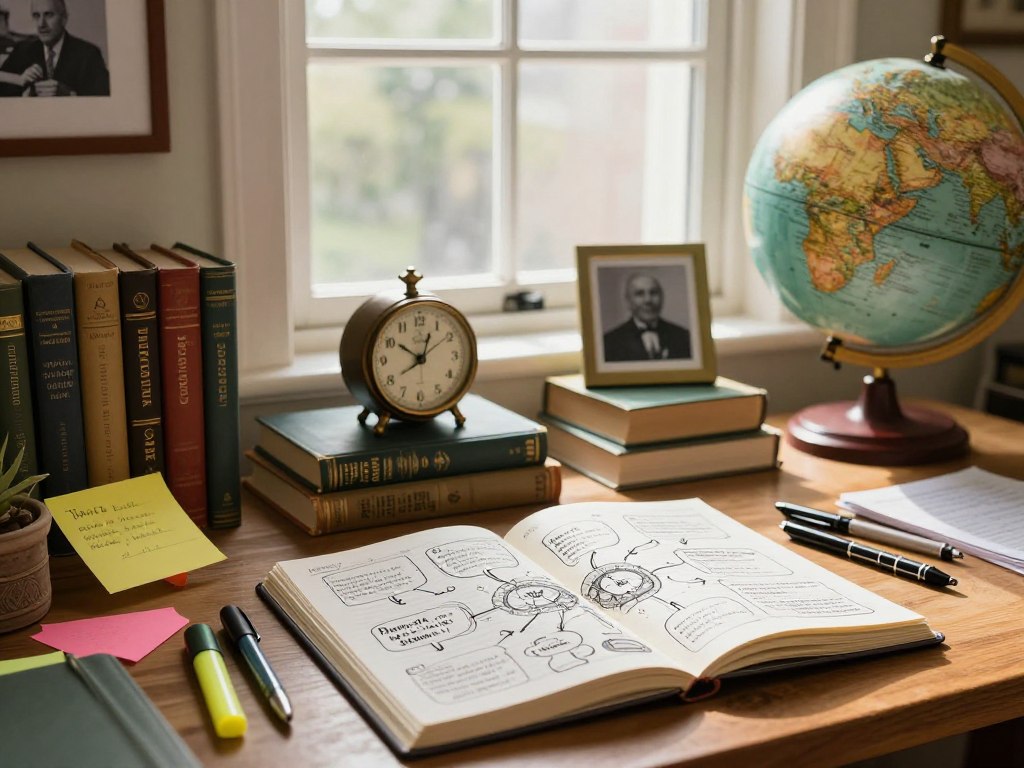
Did you know the human brain can process visual info 60,000 times faster than text? This shows how using different methods can help remember historical dates and events.
Learning about historical dates and events is key to understanding the past. But, traditional rote memorisation can be dull and not very effective. Luckily, there are many study strategies and memory techniques that can make it more fun and efficient.
This article will share useful history study tips for remembering historical dates and events without just memorising them. By using these methods, students can gain a better grasp of historical contexts. This can also boost their academic results.
Key Takeaways
- Effective study strategies can greatly help in remembering historical dates and events.
- There are better ways to learn than just memorising, making it more interesting.
- We’ll look at practical tips and techniques to improve historical date recall.
- Understanding historical contexts is vital for doing well in school.
- Using these methods can lead to better grades overall.
Table of Contents
- Why Traditional Memorisation Falls Short for History Students
- Build Context Around Historical Events
- Create Visual Timelines and Mind Maps
- Remember History Dates Using Memory Palaces
- Apply Mnemonic Devices and Acronyms
- Recognise Patterns in Historical Dates
- Transform Dates Into Compelling Stories
- Implement Active Recall and Self-Testing
- Use Spaced Repetition for Long-Term Retention
- Make Personal Connections to Historical Dates
- Combine Multiple Techniques for Maximum Effect
- Conclusion
Why Traditional Memorisation Falls Short for History Students
Traditional memorisation has long been a key part of history education. But, it often fails to help students keep information for long. History students face a big challenge: not just memorising dates and events, but keeping them in mind over time.

The Limitations of Rote Learning
Rote learning, or memorising through repetition, is common in history classes. But, it has big drawbacks. It doesn’t help students understand or connect historical events. This makes it hard for them to remember what they’ve learned.
Rote learning doesn’t engage the brain deeply. Students don’t form a strong connection with the material. This leads to a shallow understanding that doesn’t last.
How Your Brain Actually Processes Historical Information
Our brains process information in complex ways, not just through rote learning. Historical facts stick better when linked to other relevant info. This creates a network of associations.
Deeper engagement with historical info helps students retain it better. This method is different from rote learning, which treats each piece of info as separate.
The Forgetting Curve and Why It Matters
The forgetting curve shows how our memory of new info fades over time without effort. Hermann Ebbinghaus first suggested this. It shows the need to review material at the right times to avoid forgetting.
For history students, knowing the forgetting curve is key. It points to the need for a smarter way to learn and remember historical info. By understanding this natural forgetting, students can use strategies to keep their knowledge longer.
Build Context Around Historical Events
To really get historical events, you need to understand them fully. This means knowing their causes, effects, and where they fit in history.
Connect Events to Their Causes and Consequences
Historical events are like pieces of a puzzle. To remember them well, you must see how they connect. This means knowing what led to an event and what happened next.
Cause and Effect Analysis: When studying an event, think about what caused it and what happened after. Making a timeline or diagram can help you see the sequence of events.

Understand the Historical Narrative Flow
The story of history isn’t always straightforward. Events often link together in complex ways. It’s important to see how each event adds to the bigger story.
Chronological Understanding: Try to arrange events in order, both individually and as part of a larger timeline. This includes other important events happening at the same time.
Link Multiple Events Through Thematic Connections
Thematic connections can tie together different historical events. These links can be political, economic, or social.
Political Connections Across Time Periods
Political events, like revolutions or government changes, can have lasting effects. For example, the French Revolution’s impact was felt for centuries, shaping political movements.
Economic and Social Threads
Economic changes, like trade or technology, and social shifts, like changes in attitudes or demographics, can also connect events. These threads weave through history, linking different times and places.
| Theme | Historical Events | Time Period |
|---|---|---|
| Revolution | French Revolution, Russian Revolution | 18th-20th Century |
| Economic Change | Industrial Revolution, Globalisation | 18th-21st Century |
| Social Movement | Civil Rights Movement, Women’s Suffrage | 20th Century |
By exploring these thematic connections, you can deepen your understanding of historical events. This makes them easier to remember and grasp.
Create Visual Timelines and Mind Maps
Visualising historical events helps us remember dates and understand the bigger picture. By making timelines and mind maps, students can see how events are connected.

Design Your Own Timeline System
Creating a timeline needs thought on layout, organisation, and looks. A good timeline makes it easy to spot important events and their order.
Horizontal vs Vertical Timeline Layouts
Choosing between a horizontal or vertical timeline is key. Horizontal timelines are good for short periods. Vertical timelines work better for longer ranges.
Colour-Coding Different Historical Periods
Using colours for different times or themes makes timelines easier to follow. This colour-coding system helps us see the different eras or event types.
Adding Visual Symbols and Icons
Adding symbols and icons to timelines makes them more interesting. For example, using icons for different events (like wars or cultural movements) makes it easier to understand.
Use Mind Mapping for Complex Events
Mind mapping is great for complex events with many factors. It lets students organise the event’s causes, effects, and key players in a visual way.
Combine Timelines With Geographic Maps
Linking timelines with maps gives a deeper view of history. It shows both when and where events happened. This is very helpful for events that moved or changed places.
Remember History Dates Using Memory Palaces
The Memory Palace technique is a unique way to remember historical dates. It links them to places in your mind. This method, also known as the method of loci, has been around for centuries.

What Is the Memory Palace Technique?
This technique uses a familiar place like your home or school. You link items or events to spots in that place. By walking through it mentally, you can recall the information.
How to Build Your History Memory Palace
To make a Memory Palace for historical dates, follow these steps:
Choose Your Familiar Location
Pick a place you know well, like your childhood home or a route you often take. The more familiar it is, the easier it is to remember.
Place Historical Events in Specific Spots
Find key historical events and link them to spots in your chosen place. For example, you might connect the Battle of Hastings (1066) with a room in your house.
Create Vivid Mental Images
Make your memories stick by creating vivid images. The more unusual or striking the image, the better it will stay in your memory.
For example, to remember the first moon landing (1969), imagine a giant spaceship landing in your living room. Picture astronauts stepping out onto your coffee table.
Practice Walking Through Your Palace Regularly
Practice is key to keeping your memories sharp. Spend a few minutes each day walking through your Memory Palace. Recall the historical events at each spot.
| Step | Description | Example |
|---|---|---|
| 1. Choose Location | Select a familiar place | Childhood home |
| 2. Associate Events | Link historical events to specific spots | Battle of Hastings in the living room |
| 3. Create Images | Form vivid mental images | Spaceship landing on the coffee table |
| 4. Practice Regularly | Mentally walk through your Memory Palace | Daily recall practice |
Apply Mnemonic Devices and Acronyms
Mnemonics are a smart way to remember historical facts. They help you recall dates and events better. You can use different methods to improve your memory.
Create Memorable Phrases for Date Sequences
One good method is to make sentences where the first letter of each word spells out a date or event. For example, to remember the Battle of Hastings (1066), you could say “Ten men went to Hastings in sixty-six.”
To get better at this, follow these steps:
- Make a sentence that means something to you.
- Use pictures to help you remember the sentence.
- Keep practicing to recall the sentence.
Use Rhymes and Songs for Key Dates
Rhymes and songs are great for remembering dates. They make the information stick in your mind. For instance, you could make a rhyme like “In fourteen ninety-two, Columbus sailed the ocean blue.”
To use this method, do the following:
- Find important dates you want to remember.
- Make a rhyme or song with these dates.
- Repeat it often to help your memory.
Develop Number-to-Word Systems
Number-to-word systems change numbers into words or images that are easier to remember. The Major System is a popular one.
The Major System for Converting Numbers
The Major System links numbers to consonant sounds, helping you form words. For example, the number 3 might sound like “m,” and 4 like “r.” So, 34 could be “m-r” or “more.”
| Number | Consonant Sound | Example Word |
|---|---|---|
| 1 | t, d | tea |
| 2 | n | no |
| 3 | m | my |
Creating Your Own Number Associations
You can also make your own number associations. Use personal experiences or familiar patterns. For example, if you know someone born on the 15th, you could link 15 to their name.
By using memorable phrases, rhymes, and number-to-word systems, you can remember historical dates and events better.
Recognise Patterns in Historical Dates
Spotting patterns in historical dates boosts memory and understanding of past events. It makes history easier to grasp and more fun. This way, students can better remember and organise the information.
Century and Decade Patterns
Many big events happen in certain centuries or decades. For example, big revolutions were in the late 18th century. Important scientific discoveries were in the early 20th century. Spotting these patterns helps group events together, making them easier to remember.
Clustered Events in Time
Some times in history have lots of big events close together. Like 1066, a key year in English history because of the Norman Conquest. Seeing these clusters helps link events that happened around the same time, improving recall.
Mathematical Relationships Between Dates
Some dates are linked by simple maths. For example, some events are a century or decade apart. Noticing these maths links helps remember multiple dates.
| Event | Date | Mathematical Relationship |
|---|---|---|
| Start of World War I | 1914 | 100 years after the start of the Napoleonic Wars (1814) |
| End of World War II | 1945 | 30 years after the end of World War I (1918) |
Relative Dating Instead of Absolute Dates
Try using relative dating instead of exact dates. This means knowing the order and timing of events. For example, knowing the Treaty of Versailles was after World War I and before World War II helps without needing exact dates.
- Identify key events and their order.
- Understand the time gaps between significant events.
- Use these relative timelines to anchor your memory.
By using these methods, you can understand historical timelines better. And you’ll get better at remembering historical dates.
Transform Dates Into Compelling Stories
Turning historical dates into stories can really help us remember them better. By making up tales around these events, students can recall important dates more easily. They also get to see why these dates are so significant.
Build Narrative Connections Between Events
Connecting historical events into one story makes it easier to remember. This means linking events through their causes and effects. It makes the story flow better and is more logical.
For example, when looking at World War I, we can link the assassination of Archduke Franz Ferdinand to the alliances and militarism of the time. This makes the story stick in our minds.
Create Character-Driven Historical Stories
Making historical figures into characters and imagining ourselves in their times makes events more relatable. This uses our emotional memory to help us remember better.
Personalise Historical Figures
To make historical figures more real, think about their goals, struggles, and successes. For instance, knowing Napoleon’s drive and strategic mind makes his conquests more interesting and easy to remember.
Imagine Yourself in Historical Scenarios
Putting ourselves in historical situations helps us connect emotionally with the events. Imagine being in a big battle or living through social changes. This emotional link helps us remember more.
| Historical Figure | Event | Emotional Connection |
|---|---|---|
| Napoleon Bonaparte | Battle of Waterloo | Defeat and Exile |
| Marie Curie | Discovery of Radium | Groundbreaking Achievement |
| Martin Luther King Jr. | March on Washington | Advocacy for Civil Rights |
Use Emotion to Strengthen Memory Retention
Emotion is key to remembering things. By linking historical events to feelings, we can remember them better. This can be done by creating vivid pictures or connecting events to our own experiences.
For example, understanding the impact of events like the Holocaust or the Great Fire of London can stir strong feelings. This makes these events more memorable.
By using these methods—making connections, creating character-driven stories, and tapping into emotions—students can turn historical dates into engaging stories. These stories are not just memorable but also fun to learn.
Implement Active Recall and Self-Testing
Active recall is a great way to remember historical dates and events. It makes you recall information from memory, not just read it. This helps you keep the information longer.
Create Your Own Practice Questions
Creating your own practice questions is a good way to use active recall. Pick important historical events and dates. Then, test yourself to see if you remember the details.
Start by reviewing your notes and textbook. Find the key events and dates. Make questions that make you recall specific details.
For example, you might ask: “What were the main causes of the French Revolution?” or “When did the Treaty of Versailles come into effect?” Regularly testing yourself helps you learn better and see where you need more study.
Use Flashcards Strategically
Flashcards are also great for active recall. They help you quickly test yourself on key terms and concepts. You can use physical flashcards or digital apps, whichever you prefer.
Digital vs Physical Flashcards
Digital flashcards are easy to carry and study anywhere. They often have features like spaced repetition to help you learn better. Physical flashcards, on the other hand, are more hands-on and can help with memory.
The Leitner System for History Dates
The Leitner System is a way to use flashcards effectively. It has three boxes: new cards, cards you’ve gotten right once, and cards you’ve consistently gotten right. Cards move from one box to another based on your performance. This means you focus on the information that’s hard for you.
Test Yourself in Different Formats
Varying the format of your tests makes self-testing more effective. Try written tests, oral recitation, and timeline exercises.
Written Tests and Oral Recitation
Written tests are like many exams. Oral recitation helps you feel more confident and improves your verbal explanation skills.
Timeline Reconstruction Exercises
Timeline exercises test your understanding of event sequences. Start with broad timelines and add details as you get more confident.
Use Spaced Repetition for Long-Term Retention
The spacing effect is key to keeping information in your memory. It uses spaced repetition. This means reviewing material at longer intervals to make it stick in your long-term memory.
Understanding the Spacing Effect
The spacing effect shows that learning in bits over time works better than cramming. It’s vital for history students to remember lots of info.
Studies prove that spaced repetition boosts long-term memory. It lets your brain process and file away info better. Adding spaced repetition to your study plan can really help your memory.
Create a Structured Review Schedule
To use spaced repetition well, make a review schedule. This plan should show when to check on historical dates and events.
Initial Review Intervals
Start with reviews that are close together, like a few days or a week. For example, check dates on day one, then again on day three, and once more on day seven.
Long-Term Maintenance Reviews
As you get better, stretch out the time between reviews. After a month, review the same dates every few months to keep them fresh in your mind.
Adjust Intervals Based on Difficulty
Change how often you review based on how hard the material is. Tough dates or events need more frequent checks. Easier ones can be reviewed less often.
Customizing your review schedule to the info’s complexity makes spaced repetition more effective. This boosts your memory of historical facts.
Make Personal Connections to Historical Dates
Linking historical dates to your own life can boost your memory. This method makes history more interesting and helps you remember better. It creates strong connections that stick in your mind.
Relate Events to Your Own Life Experiences
Connecting historical dates to your life is a great way to remember them. For example, if you took a big trip on a certain date, link that date to a historical event. This personal touch makes the event easier to recall.
- Think about important events in your life.
- Find historical events that happened around the same time.
- Make a mental or written note to link them, improving your memory.
Compare Historical Dates to Familiar Ones
Comparing historical dates to ones you know well is another strategy. If a historical event happened near your birthday, use that to remember it. This method uses your existing knowledge to help you remember new information.
Using dates you already know can help you remember historical ones. It builds on what you already remember, making it easier to learn more.
Visit Historical Sites and Museums When Possible
Seeing historical sites and museums can make events more real. Viewing artifacts and documents can make dates stick in your mind. It’s like experiencing history yourself.
Experiencing history firsthand can spark your interest. It makes learning about dates more fun. Try to visit historical sites or museums to deepen your understanding.
Connect Dates to Popular Culture References
Connecting historical dates to pop culture can also help. Movies, books, or songs about historical events can make them memorable. For example, watching a film about an event can help you remember the date.
- Find pop culture references related to historical dates you want to remember.
- Use these references as memory aids by linking the historical date to the details of the reference.
- Review these connections often to keep your memory sharp.
By using these strategies, you can make historical dates more memorable and interesting. This approach helps you build a strong network of associations.
Combine Multiple Techniques for Maximum Effect
Integrating different techniques can create a strong study system for you. The secret to mastering history is mixing various methods. This boosts retention, understanding, and recall.
Develop Your Personalised Study System
Building a study system that fits you means picking the right techniques. It’s about being open to change and adapting your methods as needed.
Start With Foundation Techniques
Start with basics like visual timelines and mnemonic devices. These techniques lay a solid foundation for more complex strategies.
Layer Advanced Methods Gradually
After mastering the basics, add advanced techniques like memory palaces and spaced repetition. This layered approach strengthens your learning and boosts retention.
Track What Works Best for You
It’s key to see which techniques work best and adjust your system. Keep track of what’s effective and what’s not. Be ready to change your approach as needed.
| Technique | Effectiveness | Frequency of Use |
|---|---|---|
| Visual Timelines | High | Daily |
| Mnemonic Devices | Medium | Weekly |
| Memory Palaces | High | Bi-Weekly |
Adjust Your Approach for Different Historical Periods
Each historical period might need a unique study method. For example, complex events might need timelines and mind maps. Key figures might be better remembered through character-driven stories.
Combining multiple techniques helps you grasp historical events deeply. By tailoring your study system to each period’s needs, you can reach your full learning capacity.
Conclusion
In this article, we’ve looked at many ways to remember historical dates and events. We’ve moved away from just memorising facts. Instead, we’ve talked about creating context, making timelines, and using mnemonics to help us remember better.
These methods help us connect more deeply with history and remember important dates. You can use memory palaces, spaced repetition, or find personal connections to events. There’s a method for everyone.
As you keep studying history, try out these techniques. Mix them in a way that suits you. This will not only help you remember dates but also deepen your understanding of history.

