
 Paul Scott
Chemistry is everywhere, from the air we breathe to the medicines we take. Yet, many students find it hard to understand. This is often because they lack good study methods.
Understanding chemistry is more than just memorising formulas and reactions. It’s about seeing the world in a new light. By using chemistry study tips, students can get a better grasp of the subject and do well in exams.
This article will cover the basics of the periodic table. It will also share effective study techniques and give tips on exam prep.
Key Takeaways
- Understanding the periodic table is key to mastering chemistry.
- Good study methods can really boost your chemistry grades.
- Practising problem-solving helps you get chemical reactions.
- Having a study routine keeps you on track.
- Using visual aids makes complex concepts easier to understand.
Understanding the Fundamentals of Chemistry Learning
To do well in chemistry, you need to get the basics right. Chemistry is all about building on each concept. So, knowing the basics well is key to moving forward.

Why Chemistry Requires a Different Study Approach
Chemistry is different from other subjects. It’s not just about memorising stuff. You need to understand the underlying principles and how they connect. Effective chemistry study techniques include using visuals, doing experiments, and applying theory to real life.
Chemistry can be tricky because many concepts are abstract. Using visual aids and models helps a lot. Also, chemistry is all about solving problems. You need a systematic way to apply chemical principles and equations.
Building a Strong Foundation Before Advanced Topics
Mastering the basics is essential for chemistry. This includes the periodic table, atomic structure, and chemical bonding. Knowing these well is important before tackling harder subjects like organic or biochemistry. Mastering chemistry begins with a solid understanding of these basics.
To build a strong foundation, focus on understanding, not just memorising. Engage with the material by solving problems, discussing, and linking concepts to real life or practical uses.
Developing the Right Mindset for Chemistry Success
Having a positive mindset is key to doing well in chemistry. It means facing challenges, not giving up, and seeing failures as chances to learn. A growth mindset helps you learn and apply chemistry concepts better.
Chemistry study tips often talk about the importance of regular practice, asking for help, and staying motivated. By following these tips, you can build a strong chemistry foundation and succeed in your studies.
Mastering the Periodic Table: Your Chemistry Roadmap
The periodic table is like a map for chemistry. It helps students and chemists understand the many elements and their properties.
Learning Element Groups and Their Properties
First, learn about the different element groups and their traits. The table is split into groups like alkali metals, halogens, noble gases, and transition metals.
Alkali Metals, Halogens, and Noble Gases
Alkali metals are in Group 1 and are very reactive. They include lithium and sodium. Halogens in Group 17 are also reactive, with chlorine and iodine being examples. Noble gases in Group 18 are not reactive, like helium and neon.
- Lithium (Li) – Highly reactive alkali metal
- Chlorine (Cl) – Reactive halogen
- Helium (He) – Inert noble gas
Transition Metals and Their Characteristics
Transition metals are in the d-block. They can form ions with different charges and are good catalysts. Iron, copper, and silver are examples.
| Element | Symbol | Characteristic |
|---|---|---|
| Iron | Fe | Good catalyst |
| Copper | Cu | Excellent conductor |
| Silver | Ag | High thermal conductivity |
Understanding Periodic Trends and Patterns
Knowing periodic trends helps predict how elements behave. Important trends include atomic radius, ionization energy, electronegativity, and reactivity patterns.
Atomic Radius and Ionisation Energy
The atomic radius gets smaller from left to right in a period because of more nuclear charge. Ionization energy increases as you move right in a period.
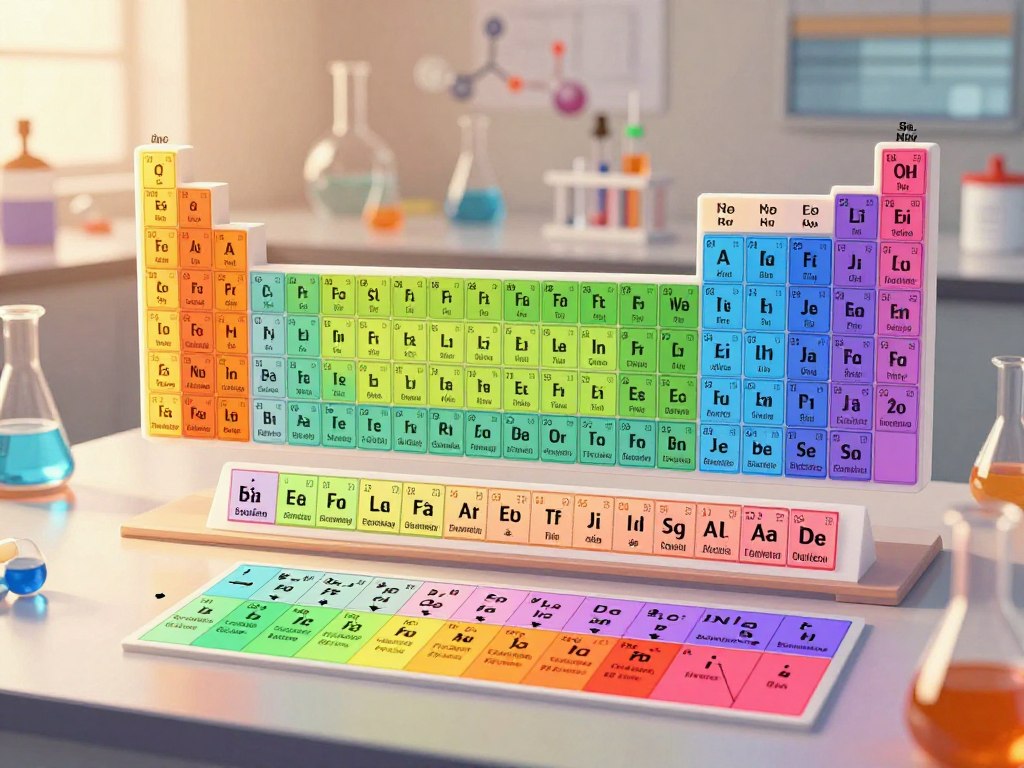
Electronegativity shows how well an atom pulls electrons in a bond. It gets higher as you move right in a period. Reactivity patterns change across the table, with fluorine being very reactive.
Creating Effective Periodic Table Memory Aids
To remember the periodic table, making good memory aids is key. Use mnemonics, flashcards, and visual aids.
- Create a mnemonic for the first 20 elements.
- Use flashcards to recall element symbols and properties.
- Draw the periodic table from memory regularly.
How to Study Chemistry: Essential Techniques That Work
To do well in chemistry, it’s key to use effective chemistry study techniques. These help you understand and remember better. Chemistry builds on itself, so a strong base is vital.

The Three-Step Chemistry Study Method
Studying chemistry in a structured way boosts your understanding and memory. Here’s a three-step method that works well:
Step 1: Preview and Identify Key Concepts
Start by previewing the material to grasp its scope and key points. Look at headings, subheadings, and summaries to see what’s covered.
Step 2: Active Reading with Note-Taking
Active reading is more than just reading. It means engaging with the material by taking notes, asking questions, and summarising in your own words.
Step 3: Practice and Application
It’s important to practice and apply what you’ve learned. Begin with simple problems and move to harder ones. Use textbooks, online platforms, and past exams for practice.
Connecting Concepts Instead of Memorising Facts
Chemistry isn’t just about memorising formulas and reactions. It’s about grasping the underlying principles and connecting concepts. Try linking new info to what you already know, building a network of ideas.
- Find the core principles behind a reaction or process.
- Use analogies to understand complex concepts.
- Talk about topics with peers or teachers for new views.
Using Multiple Resources for Complete Understanding
No one resource can cover all of chemistry. Use multiple resources like textbooks, online tutorials, videos, and study groups for a full understanding.
- Textbooks for basic knowledge.
- Online resources for extra explanations and practice.
- Laboratory experiments to apply what you’ve learned.
By following these chemistry study tips and techniques, students can grasp chemistry better. This makes it easier to master the subject and do well in exams.
Active Learning Strategies for Chemistry Success
Chemistry students can boost their understanding by using active learning. This means more than just reading or listening. It helps them keep information better.
Teaching Chemistry Concepts to Others
Teaching chemistry to others is a top active learning strategy. Explaining complex topics to friends or family helps students get it better. It also shows where they need more practice.
Try to explain complex ideas simply. This helps you remember them better and improves your communication skills.
Creating Your Own Problems and Solutions
Making your own chemistry problems and solving them is a great strategy. It makes you apply what you know to real-life situations. This boosts your problem-solving skills.
- Create problems from past exams or textbooks.
- Solve them without looking at the answers.
- Check your work to find mistakes and learn from them.
Using Flashcards Effectively for Chemical Concepts
Flashcards are great for remembering key chemistry terms and reactions. Here’s how to use them well:
What to Include on Chemistry Flashcards
Write key terms on one side and their meanings on the other. For reactions, list reactants on one side and products on the other.
Use a spaced repetition schedule for reviewing. Start with daily reviews, then increase the time between them.
| Day | Review Interval |
|---|---|
| 1-3 | Daily |
| 4-7 | Every other day |
| 8+ | Weekly |
Mastering Chemical Equations and Stoichiometry
To do well in chemistry, you need to understand chemical equations and stoichiometry. These key ideas help chemists see how much of each substance is needed in reactions.
Step-by-Step Approach to Balancing Equations
Balancing chemical equations is a key skill. It needs a clear method. Here’s how to do it right:
Counting Atoms and Identifying Imbalances
The first thing is to count the atoms of each element on both sides. This shows where the equation is not balanced.
Using Coefficients to Balance Equations
After spotting the imbalances, use numbers in front of formulas to fix it. It’s important to adjust these numbers carefully. This ensures the number of atoms is the same on both sides.
Understanding Mole Calculations and Conversions
Mole calculations are key in stoichiometry. They help chemists measure substances in reactions. Knowing how to switch between moles, mass, and particles is essential.
- Use the molar mass to change mass to moles.
- Apply Avogadro’s number to switch between moles and particles.
Common Mistakes to Avoid in Stoichiometry
Students often make mistakes in stoichiometry, like:
- Not balancing chemical equations right.
- Mixing up molar mass with molecular mass.
- Getting the unit conversions wrong.
Knowing these common errors helps students avoid them. This way, they can better understand stoichiometry.
Developing Strong Problem-Solving Skills
To master chemistry, students need a systematic way to solve problems. They should break down complex questions into simpler parts. This skill is key for solving chemistry exam problems and real-world challenges.
Breaking Down Complex Chemistry Problems
Complex chemistry problems can seem overwhelming. But, they can be tackled by following a structured method. This involves several important steps:
Reading and Identifying Given Information
The first step is to read the question carefully and note the given information. This might include chemical formulas, reaction conditions, or physical properties.
Determining What the Question Is Asking
After identifying the information, the next step is to understand the question. It’s important to interpret the problem and know what calculation or reasoning is needed.
Selecting the Right Formula or Approach
With a clear problem understanding and information, the next step is to choose the right formula or method. This might involve recalling chemical principles, equations, or laws.
Practising Progressive Difficulty Levels
Practising problems of increasing difficulty is vital for developing problem-solving skills. This approach boosts confidence and competence, allowing students to handle more complex problems.
- Begin with simple problems to lay a solid foundation.
- As you grow more confident, move to more challenging problems.
- Try different problem types to broaden your understanding.
Learning from Mistakes and Wrong Answers
Mistakes are a natural part of learning, including in chemistry problem-solving. Instead of getting discouraged by errors, use them as chances to learn and get better.
Reviewing mistakes helps spot gaps in understanding and reinforces the right methods. By understanding what went wrong and how to fix it, students can improve their problem-solving skills and avoid repeating mistakes.
Memory Techniques for Chemistry Concepts
Mastering chemistry is not just about understanding concepts. It also requires effective memory techniques to recall complex information. Chemistry has many elements, compounds, reactions, and processes. This makes it hard for students to remember key details.
Mnemonics for Chemical Rules and Formulas
Mnemonics are great tools for remembering complex chemical rules and formulas. They help by linking new information to something familiar, like a word or image. This makes it easier for students to recall important chemistry concepts.
For example, “Please Excuse My Dear Aunt Sally” helps remember the order of operations in math. It’s also useful for balancing chemical equations: Parentheses, Exponents, Multiplication and Division, and Addition and Subtraction.
Visual Learning Through Diagrams and Models
Visual learning is another effective way to remember chemistry concepts. Using diagrams and models helps students see complex molecular structures and chemical reactions. This makes them easier to understand and remember.
For instance, ball-and-stick models or space-filling models help understand the three-dimensional structure of molecules. This is key for stereochemistry concepts.
Spaced Repetition for Long-Term Retention
Spaced repetition is a technique for long-term retention. It involves reviewing material at longer intervals. This method is great for chemistry, where concepts build on each other and long-term retention is key.
Scheduling Review Sessions
To use spaced repetition, students should plan regular review sessions. Start by reviewing material soon after learning it, then increase the time between reviews.
- Review notes and textbook material one day after initial learning.
- Review again one week later.
- Review once more one month later.
Using Digital Tools for Spaced Repetition
There are digital tools like flashcard apps that help with spaced repetition. Apps like Anki or Quizlet let students create digital flashcards. They automatically schedule review sessions based on the spaced repetition algorithm.
| Tool | Description | Platform |
|---|---|---|
| Anki | A flashcard app that uses spaced repetition for efficient learning. | Web, iOS, Android |
| Quizlet | A study site that allows students to create digital flashcards and tests. | Web, iOS, Android |
| Chemistry Flashcards | A dedicated app for creating chemistry flashcards. | iOS, Android |
By using these memory techniques, chemistry students can improve their ability to recall complex concepts and formulas. This leads to better performance in exams.
Integrating Laboratory Work with Theory
To really get chemistry, you need to link lab work with theory. Lab work lets you see chemical reactions and processes up close. Theory gives you the reasons behind these happenings.
Connecting Lab Experiments to Textbook Concepts
One top chemistry study tip is to link lab work to textbook ideas. Before doing a lab, check the theory in your book. This helps you see why the experiment matters and what it shows.
- Find out what key ideas the lab is showing.
- See how the lab work ties to the theory.
- Talk about your results in terms of what you’ve learned.
Keeping Effective Lab Notes for Revision
Keeping good lab notes is key for studying chemistry well. Good notes help a lot when you’re getting ready for exams. They help you remember what you did and what you found out.
- Write down what you see and measure carefully.
- Make a note of any surprises and what they mean.
- Sum up the main points of each experiment.
Understanding Practical Applications of Chemical Principles
Chemistry is all about doing experiments and it’s used in many ways in our lives. Knowing how it’s used can make it more interesting and meaningful.
Here are some ways to see how chemistry is used:
- Look into how industries use chemical principles.
- Talk about how chemistry is used in different jobs.
- Check out the latest in chemistry research.
By mixing lab work with theory, you can really understand chemistry. You’ll also get better at using chemical knowledge in different situations.
Creating an Effective Chemistry Study Schedule
A well-organised study schedule can really help you get chemistry. It’s important to make a study plan that fits your needs. This plan should cover all you need to know.
Daily Practice Routines for Chemistry
Having a daily routine is key to mastering chemistry. Set a time each day to go over your notes, do practice problems, or read chapters. Being consistent helps build a strong chemistry base.
- Begin with 15-30 minutes of daily review, then increase as you get more comfortable.
- Use flashcards to remember important terms and formulas.
- Practice solving problems from different sources to boost your skills.
Balancing Different Chemistry Topics
Chemistry covers many topics, like organic, inorganic, and physical. It’s important to spend time on each to understand chemistry fully.
Allocating Time for Theory and Problems
It’s important to split your study time between theory and solving problems. Knowing the theory is key, but solving problems is just as important.
| Topic | Theory Time | Problem-Solving Time |
|---|---|---|
| Organic Chemistry | 30% | 70% |
| Inorganic Chemistry | 40% | 60% |
| Physical Chemistry | 50% | 50% |
Rotating Between Organic, Inorganic, and Physical Chemistry
Switching between different chemistry topics helps avoid burnout and improves memory. For example, you might focus on organic one day, inorganic the next, and physical the day after.
Optimising Study Sessions for Maximum Retention
To keep information in your mind, make your study sessions better. Use active learning methods like summarising notes, making concept maps, and teaching others.
- Try the Pomodoro Technique for focused 25-minute study sessions with 5-minute breaks.
- Review material at longer intervals to help remember it longer.
- Test yourself on the material without looking at notes or textbooks.
By using these tips, you can make a study schedule that really helps you understand and remember chemistry.
Practising and Self-Assessment Strategies
To do well in chemistry, it’s key to use good practising and self-assessment methods. These methods help you understand chemical concepts better and spot where you need to get better.
Using Past Papers and Practice Tests
Using past papers and practice tests is a top way to get ready for chemistry exams. They give you a peek at the exam style, types of questions, and how to manage your time.
- Get past papers and practice tests from trusted places, like official exam boards or educational websites.
- Use a timer to mimic exam conditions and see how you do under pressure.
- Go over your answers carefully, spotting mistakes and what you need to work on.
Identifying and Strengthening Weak Areas
Finding out where you’re not so strong is key for better learning and improvement. By focusing on these areas, you can get a better grasp of chemistry.
Keeping a Mistake Log
Keeping a mistake log is a smart way to track and learn from your errors. Write down the mistakes you make during practice tests or homework, and the right answers.
- Check your mistake log often to make sure you understand things better.
- Use the log to spot common mistakes and work on them.
Focused Practice on Problem Areas
After spotting your weak spots, it’s important to practice more on those topics. Use books, online tutorials, or practice problems to help you get it.
- Begin with easier problems and then tackle harder ones.
- Try different question types, like multiple-choice or open-ended, to challenge yourself.
Tracking Your Progress Over Time
Keeping an eye on how you’re doing is vital to stay motivated and tweak your study plan if needed. Regularly check how you’re doing and adjust your approach as necessary.
- Set achievable goals and milestones to track your progress.
- Keep a study journal or spreadsheet to record your scores and feedback.
- Enjoy your successes and figure out what you’re not quite getting yet.
Exam Preparation and Test-Taking Strategies
Getting ready for chemistry exams needs knowledge, strategy, and confidence. It’s key to have a good plan to make sure you’re ready.
Creating Comprehensive Revision Materials
One great way to get ready for chemistry exams is to make detailed revision materials. This means breaking down key concepts, formulas, and reactions into simple formats.
Summary Sheets and Formula Lists
Summary sheets and formula lists are great for quick reviews. For instance, you can make a sheet that lists important chemical reactions. It should include reactants, products, and conditions needed.
| Chemical Reaction | Reactants | Products | Conditions |
|---|---|---|---|
| Combustion of Methane | CH4 + O2 | CO2 + H2O | Heat |
| Synthesis of Ammonia | N2 + H2 | NH3 | High Pressure, Catalyst |
Concept Maps and Relationship Diagrams
Concept maps and relationship diagrams are visual aids that show connections between chemistry concepts. They help you see how different ideas are linked and organise your knowledge better.
Final Week Revision Techniques
In the last week before exams, focus your revision. This means doing more practice with past papers, reviewing your notes, and making sure you understand key concepts.
- Do more practice with past papers and mock exams.
- Review your notes and key concepts.
- Make sure you understand difficult topics well.
Managing Exam Anxiety and Time Pressure
It’s important to manage exam anxiety and time pressure to do well in chemistry exams. Techniques like deep breathing, positive self-talk, and good time management can help reduce stress and improve your performance.
- Practice deep breathing to calm down.
- Use positive self-talk to boost confidence.
- Manage your time well during the exam.
Understanding Question Types and Mark Schemes
Knowing the different types of questions and mark schemes in chemistry exams helps you prepare better. Get familiar with the exam format, including multiple-choice, short-answer, and essay questions.
By using these strategies, you can feel more confident and ready for your chemistry exams.
Conclusion
Mastering chemistry needs good study habits, regular practice, and a solid grasp of the basics. This article has shared tips to help students learn chemistry well. By following these tips, students can develop a strong way to study chemistry.
Using effective study methods like making a study plan, practicing past exams, and engaging in active learning can really help. Adding lab work to theory studies makes learning chemistry even better. This way, students can understand chemistry principles more clearly.
To do well in chemistry, staying motivated and sticking to your study plan is key. This approach helps students build a strong chemistry foundation. It leads to better grades and a deeper love for the subject. With dedication and the right study methods, mastering chemistry is definitely possible.
FAQ
What is the best way to start studying chemistry?
Start by learning the basics like the periodic table, atomic structure, and chemical bonding. A solid foundation in these areas makes it easier to understand more complex topics.
How can I effectively memorise the periodic table?
Use memory aids like mnemonics, flashcards, or diagrams to remember the periodic table. Knowing element groups and their properties helps too.
What are some active learning strategies for chemistry success?
Active learning includes teaching others, solving your own problems, and using flashcards. These methods help you understand and remember better.
How can I improve my problem-solving skills in chemistry?
Improve by breaking down complex problems into simpler ones. Start with easy problems and get harder ones as you go. Learn from mistakes and practice often.
What is the importance of laboratory work in chemistry?
Lab work connects theory to practice in chemistry. Keeping good lab notes and understanding practical uses of chemical principles helps in studying and remembering.
How can I create an effective study schedule for chemistry?
Create a study schedule with daily routines, balancing topics, and focused study sessions. Regular practice and review boost understanding and confidence.
What are some effective techniques for managing exam anxiety and time pressure?
Manage anxiety and time by making detailed revision materials and practicing under timed conditions. Knowing question types and mark schemes also helps.
How can I track my progress in chemistry?
Track progress by regularly reviewing and assessing your understanding. Identify weak areas and use past papers to check your knowledge. Keeping a progress record motivates you to keep improving.
What are some common mistakes to avoid in stoichiometry?
Avoid mistakes like incorrect equation balancing, misunderstandings in mole calculations, and unit errors. Regular practice and review help spot and fix these mistakes.
How can I use spaced repetition to improve long-term retention of chemistry concepts?
Use spaced repetition to review material at longer intervals for better retention. This method helps solidify your understanding and reduces cramming.