
 Paul Scott

Good survey question wording gives participants a clear, neutral way to report what they know, do or think. For your dissertation, questionnaire wording should ensure each item measures one defined concept and produces evidence that answers your research question.
Small wording errors can leave you with ambiguous answers that statistical analysis can’t repair. Start by choosing suitable question formats, then review the seven mistakes below before piloting your questionnaire.
Key Takeaways
- Ask about one thing at a time, using neutral language and a defined timeframe.
- Make answer options complete, non-overlapping and clearly labelled.
- Keep the questionnaire focused, then test how participants interpret it before collecting your dissertation data.
Choose Question Formats That Fit Your Research Aim
Your survey questions should follow your research question, rather than dictate it. Our guide to developing a focused research question explains how to establish that direction.
Choose question types based on the evidence you need, and match each item in your survey questionnaire to that evidence.
| Format | Example Question | Useful For |
|---|---|---|
| Yes/No | “Have you attended a university study-skills session?” | Recording a binary fact or checking eligibility. |
| Multiple Choice | “Which year of your degree are you in?” | Recording one category with a multiple choice item. |
| Checkbox | “Which library services have you used this term? Select all that apply.” | Recording several applicable categories. |
| Numeric Response | “How many paid hours did you work last week?” | Measuring a defined quantity. |
| Open-Ended | “What prevented you from attending the session?” | Exploring explanations you haven’t anticipated. |
A yes/no item suits a binary factual question. Use yes/no for eligibility checks in screening questions. Selecting one answer and selecting every applicable answer require different instructions.
AAPOR’s survey research guidance places questionnaire design within the wider research process. Clear questions still need suitable recruitment and analysis.
Also distinguish reported behaviour from observed behaviour. A student’s account of attendance may differ from attendance records. A one-off observational survey can identify associations, but it doesn’t establish causation.
Remove Questions That Combine Ideas or Push Answers
1. Asking Two Things at Once
These questions ask participants to assess two different things with one answer.
Before: “How satisfied are you with the library’s opening hours and study spaces?”
Someone might welcome late opening but struggle to find a seat. Their answer won’t reveal which experience shaped their rating.
After: “How satisfied are you with the library’s opening hours?” Then ask separately about study spaces.
During editing, check whether an item asks for more than one judgement. “And” or “or” can flag double-barrelled questions, though neither automatically makes a question defective.

2. Leading Respondents Towards Agreement
Some questions suggest that a particular answer is desirable or expected.
Before: “How helpful was the university’s excellent wellbeing service?”
After: “How helpful or unhelpful was the university’s wellbeing service?”
Only show that follow-up to people who used the service. Otherwise, you’re asking participants to evaluate an experience they haven’t had.
When reviewing leading questions, check both the prompt and the answer choices. Favourable adjectives can create a framing effect by making a preferred answer seem expected.
Pew Research Center’s question-writing guidance explains why wording and response choices deserve careful attention.
Also consider acquiescence bias, the tendency to agree with statements. Direct evaluations often work better than repeatedly asking participants whether they agree with favourable claims.
Make Every Question Easy to Interpret
3. Using Double Negatives
Negative constructions increase the effort needed to understand a question. Double negatives can leave respondents answering the opposite of what they intended.
Before: “Do you disagree that students should not receive deadline extensions?”
After: “Should students be eligible for deadline extensions?”
Provide clear answers, such as “Yes”, “No” and “Unsure”, where these fit your aim.
Avoid reverse-worded items simply to make respondents pay attention. However, if you’re using a validated instrument, retain its authorised wording and scoring rather than casually rewriting individual items.
4. Leaving Key Terms or Timeframes Undefined
Words such as “regularly”, “often” and “recently” mean different things to different respondents. “Study time” might include lectures for one student and independent revision for another.
Before: “Do you regularly spend a lot of time studying?”
After: “During the past seven days, how many hours did you spend studying outside scheduled teaching sessions?”
Define what counts, then choose a recall period participants can manage. Longer periods may suit rare events, whilst everyday activities usually need a shorter reference period.
For multilingual questionnaires, test translated wording with intended respondents. Literal translation can change the meaning of an educational term or response label.
Give Respondents Answers They Can Use
5. Providing Overlapping or Incomplete Options
Multiple-choice categories must allow participants to locate their answer without guessing which category you intended.
Age bands such as “18 to 25” and “25 to 34” overlap at 25. For an adult-only sample, “18 to 24”, “25 to 34”, “35 to 44” and “45 or over” avoid that problem.
Add “Other” when your category list may be incomplete. However, distinguish it from “None”, “Don’t know” and “Prefer not to say”. These answers communicate different things.
6. Writing Unbalanced or Unlabelled Scales
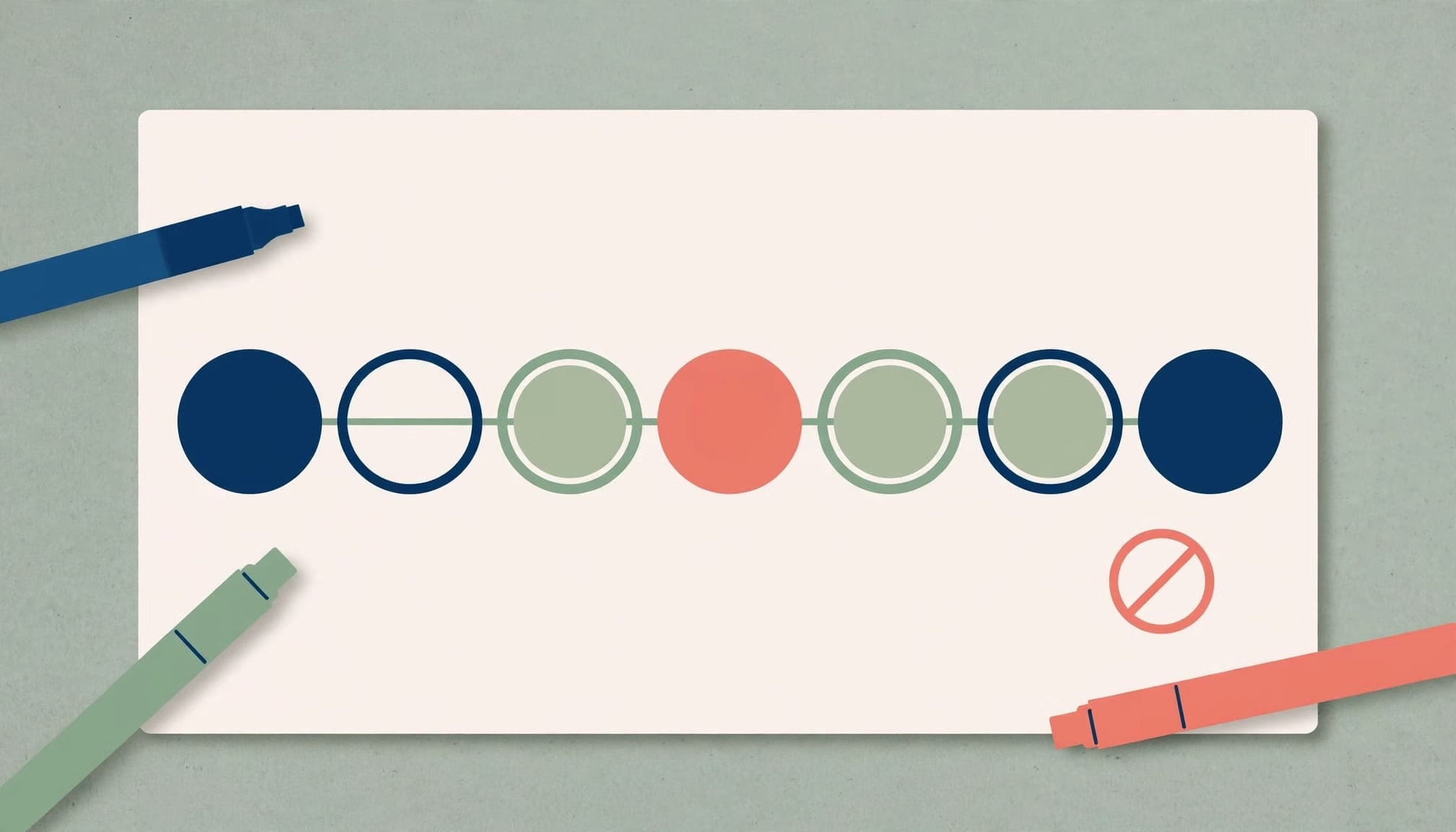
Use balanced five-point or seven-point Likert response options when measuring agreement. A five-point version is “Strongly disagree”, “Disagree”, “Neither agree nor disagree”, “Agree” and “Strongly agree”.
Include “Not applicable” separately where relevant. It isn’t the neutral midpoint: someone without relevant experience cannot meaningfully express neutrality.
For numeric rating scales, label each point so participants understand the numbers. Keep the direction consistent throughout.
A midpoint records a neutral position; “Not applicable” records that the question doesn’t fit the participant.
7. Making Sensitive Questions Judgemental
Before: “Why did you fail to attend your lectures?”
After: “Which factors affected your lecture attendance during the past four weeks?”
Judgemental wording can encourage social desirability bias: participants may report what sounds acceptable rather than what happened.
Place demographic questions, including age, location and job title, near the end unless eligibility requires them earlier. Collect only necessary details.
Our guidance on dissertation ethics approval covers participant-facing materials. Describe confidentiality accurately; don’t promise anonymity if responses remain identifiable.
Keep the Survey Short Without Losing Necessary Evidence
Set Practical Limits on Demanding Formats
Aim for completion in under five minutes where your research requirements allow. Treat this as a design target, not a reason to remove essential measures. Give participants a realistic time estimate to support a positive respondent experience.
SurveySparrow’s Survey Response Rate Benchmarks (2025) reports completion rates of 83.34% for surveys with one to three questions. This figure doesn’t set an appropriate length for every dissertation questionnaire.
As practical limits, include no more than two open-ended questions and place them on a separate final page. Configure partial-response saving consistently with participant consent.
Keep matrix questions to five rows at most. Cap ranking questions at five items. Avoid them in long questionnaires, where comparing every option adds effort and can cause respondent fatigue.
Use Routing Instead of Repeated Irrelevant Questions
Conditional questions display follow-ups only when an earlier answer triggers them. Use screening questions to establish eligibility, then show only relevant follow-ups. For example, only service users need questions about that service’s quality.
Place necessary demographic questions before the final open-ended page. Before participants begin, explain the survey’s purpose, realistic completion time and how you’ll use their data.
The Government Analysis Function’s questionnaire design guidance recommends qualitative testing to reduce respondent burden. Deleting words alone won’t solve an unnecessarily difficult task.
Pilot the Questionnaire Before Launch
A pilot should test question interpretation, technical performance and respondent experience. Recruit a small group resembling your intended participants, rather than relying entirely on friends who already understand your project.
Cognitive interviewing research describes a useful approach: investigate how people understand an item and arrive at their answer.
Use this sequence for your pilot test before launch.
- Ask testers to explain selected questions in their own words. Probe terms such as “independent study” and ask how they chose their response.
- Run the complete survey questionnaire on mobile with mobile users, then test it on desktop. Check consent, eligibility screening, conditional routing, answer selection and submission.
- Review survey data, completion times, skipped items and comments. Revise confusing wording, then retest changes that affect meaning or navigation.
Treat unexpected response patterns as prompts for investigation. Heavy use of “Other” may reveal missing categories. Repeated midpoint responses may reflect genuine neutrality, uncertainty or unclear wording.
Record what changed and why, so your methodology chapter can describe the development process accurately. Substantial changes may also require discussion with your supervisor or an ethics amendment.
Finally, keep wording quality separate from sample quality. Clear questions won’t remove recruitment bias. Our guide to dissertation sampling methods explains how selection affects the claims your results can support.
Frequently Asked Questions About Dissertation Survey Design
When Should I Use Open-Ended Questions?
Use them when you need participants’ explanations or expect answers you cannot categorise beforehand. Closed-ended questions are better for consistent comparisons and numerical summaries.
If your main aim concerns detailed experiences or meanings, interviews may suit the research question better than a short survey. A final comment box rarely provides interview-level depth.
What’s the Difference Between Likert and Rating Scales?
A Likert item typically presents a statement with ordered agreement options. A broader rating scale asks respondents to assess something directly, such as satisfaction or difficulty.
Strictly, a Likert scale combines several related items. For either format, clear labels and consistent direction help respondents answer accurately.
Does a Successful Pilot Prove the Survey Is Valid?
No. A pilot can reveal interpretation problems and technical faults, but it doesn’t establish every aspect of measurement quality. Your dissertation still needs a reasoned explanation of what each measure captures.
Build a Questionnaire You Can Defend
Strong survey question wording makes the relationship between your research aim, each item and its answers visible. Neutral, single-focus questions give you clearer evidence to analyse.
Before launch, remove ambiguity and test the questionnaire with intended respondents. Document those decisions so your dissertation explains both how you collected the data and what it can reasonably show.