
 Torey
Torey
If you keep rereading a biology chapter and nothing sticks, you’re not lazy. You’re using a method that feels productive, but doesn’t build recall.
To study biology well, you need two things: active recall (pulling knowledge out without looking) and feedback (checking what you missed). Add spacing, and your brain starts treating facts like tools, not trivia.
This guide gives you ready-to-use active study techniques, diagram drills that stop “blank page panic”, and a past-paper routine that turns marks into a plan.
Key Takeaways
These active study techniques accelerate learning and retention:
- Memory improves fastest when you retrieve first, then check notes.
- Use prompts that force explanation, comparison, and prediction, not just definitions.
- Redraw key biology diagrams from memory in short, repeated drills.
- Past papers work best when you log mistakes and re-attempt them later.
- Use spaced repetition to space your reviews so you meet topics again before you forget them.
Build Meaning First So Facts Have Somewhere To Stick
Rote memorization treats biology like a phone book. Biology is closer to a story with causes, effects, and characters that interact.
So start every topic by building a simple “model” in your head. For example, don’t memorize the steps of DNA replication first. First understand the goal of this biological process: one DNA molecule produces two identical copies, so the strands must separate and each serves as a template for accurate duplication. When you know the purpose, the stages stop feeling random.
A quick way to do this is blurting, where you write what you remember, then correct it. The point isn’t neat note-taking, it’s spotting gaps. This pairs perfectly with biology because gaps often reveal missing links (like why diffusion slows over distance). Concept mapping can help students visualize causal connections between topics. If you want a structured version, try this internal guide on the blurting method for active recall.
Also, use “because” sentences. If you can’t finish the sentence, you haven’t learned it yet.
If your answer doesn’t include a cause and an effect, you’re probably reciting, not understanding.
For extra context on why memorising alone fails, see practical advice on not memorising for biology{:rel=”nofollow” target=”_blank”}.
Use Active Recall Prompts That Match How Biology Exams Ask Questions
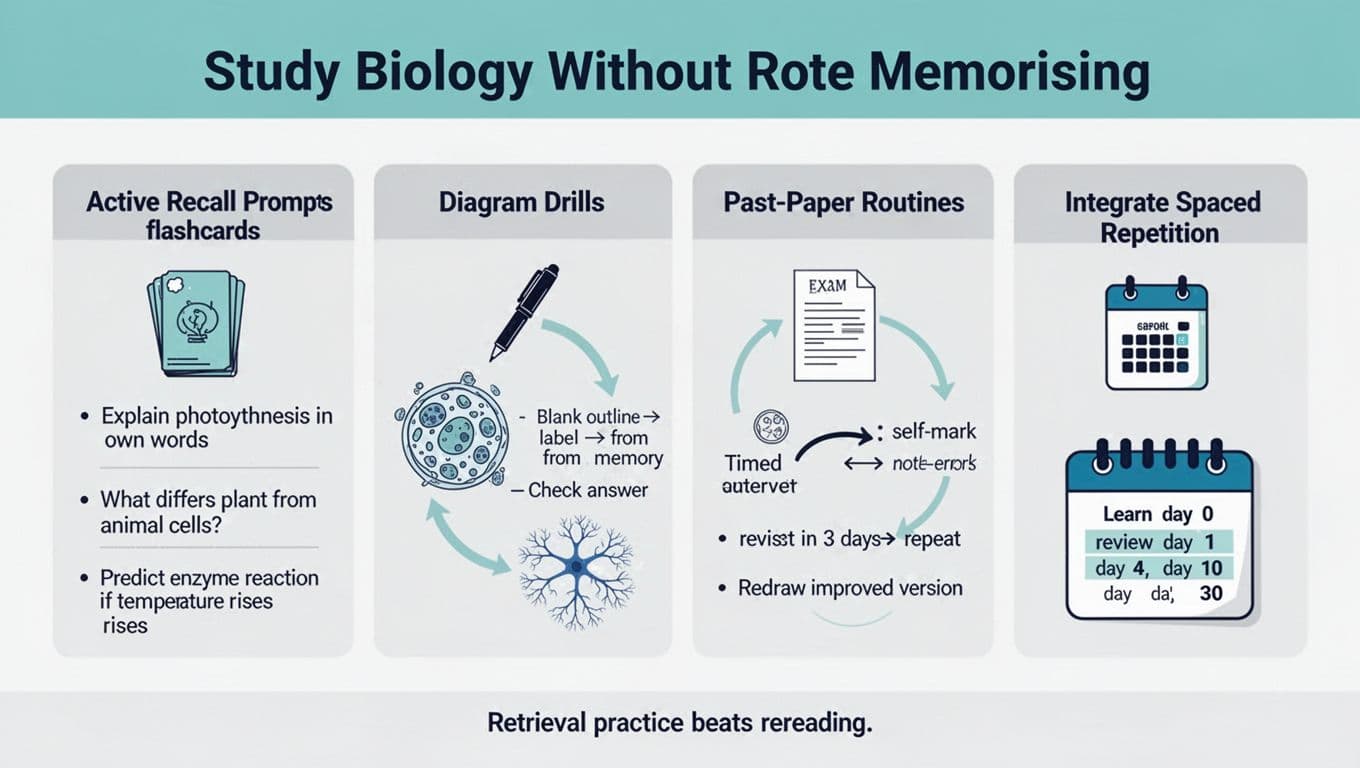
Flashcards can help with active recall, but only if you create effective practice questions that demand thinking. A card that says “What is osmosis?” is easy to memorise and easy to forget. A better card forces you to use the idea.
Aim for prompts that do at least one of these: explain, compare, predict, or apply data. Here are prompt styles that work across GCSE, A-level, and many first-year uni modules:
| Prompt type | What you do | Example |
|---|---|---|
| Explain | Teach it in plain language | “Explain enzyme specificity in 3 sentences.” |
| Compare | Show similarities and differences | “Compare diffusion and active transport.” |
| Predict | Change a condition and forecast | “What happens to transpiration if humidity rises?” |
| Diagnose | Fix a flawed statement | “What’s wrong with: ‘Mitosis creates genetic diversity’?” |
| Use Evidence | Link claim to data | “Which graph supports competitive inhibition, and why?” |
These prompts develop scientific reasoning. Keep cards short, then speak the answer out loud. It’s harder to fool yourself that way.
Next, schedule these prompts with spacing. You don’t need fancy apps, but the timing matters. This internal guide on how to use spaced repetition effectively lays out simple intervals you can copy.
If you want more examples of active recall formats, see active recall studying methods{:rel=”nofollow” target=”_blank”}.
Diagram Drills That Turn “I Know It” Into Labels From Memory
A biology diagram is a map. If you can’t draw the map, you’ll struggle to explain the journey.
Pick a small set of “high-frequency” diagrams for your course (cell ultrastructure, heart, nephron, alveoli, synapse, meiosis stages, carbon cycle, metabolic pathways like photosynthesis). Diagram drills, powerful visual strategies, involve drilling them in loops.
Here’s a routine that stays quick and slightly uncomfortable (which is the point):
- Start with a blank page, no notes.
- Draw the outline in 60 to 90 seconds.
- Add labels and arrows from memory.
- Check against your notes or mark scheme.
- Redraw immediately, correcting only what you missed.
That last redraw matters because it replaces the wrong version in your head.
When you check, don’t just tick labels. Ask what each structure does, and why its shape helps. For example, “many mitochondria” means nothing unless you connect it to high ATP demand.

A strong diagram answer is usually three parts: correct structure, clear labels, and a sentence that links structure to function.
Past-Paper Routines That Convert Mistakes Into Marks
Practice exams aren’t just “practice”. They’re a searchlight. They show what you can recall under pressure, and what your brain drops first.
Start earlier than you think, but keep it controlled. One timed section beats three hours of untimed comfort.
Use this loop, a core part of test preparation, twice a week:
- Attempt timed (even if you feel unready).
- Mark strictly using the mark scheme.
- Make an error log, central to problem-solving training, with three columns: topic, mistake type, fix.
- Redo the same free response questions after 3 days, then again after a week.
Mistake type is the key. Was it missing knowledge, sloppy wording, or misreading the question? Each needs a different fix. Missing knowledge needs active recall prompts. Sloppy wording needs you to copy the mark scheme phrasing once, then re-answer without it. Misreading needs you to underline command words (describe, explain, evaluate) before you write.
To support the idea that biology revision should mix understanding with practice, this guide on how to study for a biology exam{:rel=”nofollow” target=”_blank”} matches the same approach.
If you want a broader structure for revision weeks, this internal piece on how to study effectively for exams helps you plan time without burning out.
Conclusion: Study Biology By Retrieving, Checking, And Spacing
When you study biology without rote memorization, you stop collecting facts and start building recall you can use. Active recall prompts make your brain produce answers, diagram drills make structure feel familiar, and past papers teach you what examiners reward. Add spacing and you’ll remember more with less panic. Pick one topic today, and run the full study cycle once.
Frequently Asked Questions About Studying Biology Without Rote Memorising
How Do I Study Biology If I’m “Bad At Memorising”?
Treat memorising as a side effect, not the goal. Use analogies and a chunking strategy to simplify complex ideas, then retrieve first (questions, blurting, diagrams) before correcting. With spacing, recall improves even if your memory feels weak.
Should I Make Flashcards For Everything?
No. Make cards for things that get confused or tested often (key processes, comparisons, common misconceptions). For complex topics, study groups and peer teaching are great alternatives. For the rest, use mixed prompts and past-paper questions.
How Long Should Diagram Drills Take?
Keep them short, usually 5 to 12 minutes per diagram cycle. Several quick redraws beat one long, perfect copy.
What If Past Papers Feel Too Hard Right Now?
Start with one page or one data question. Mark it, log errors, then re-attempt after a few days. Difficulty is useful because it shows you what to fix next.
Is Rereading Ever Useful For Biology?
Yes, but mainly for quick orientation before active recall, using learning objectives as a guide for what to look for. Try the SQ3R method as a structured way to read, then set a timer, close the book, and test yourself straight away.